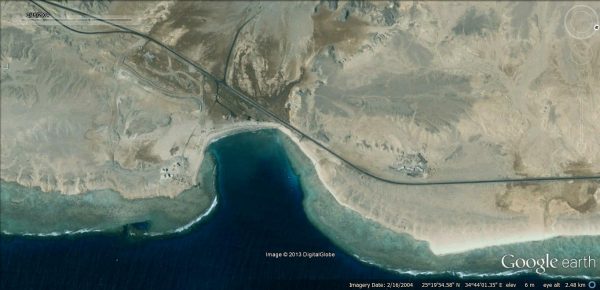
Abu Dabbab Bay
If you wish to swim or dive at Abu Dabbab contact steven@marsaalam.com or contact Steven via WhatsApp on +20 102 999 9978
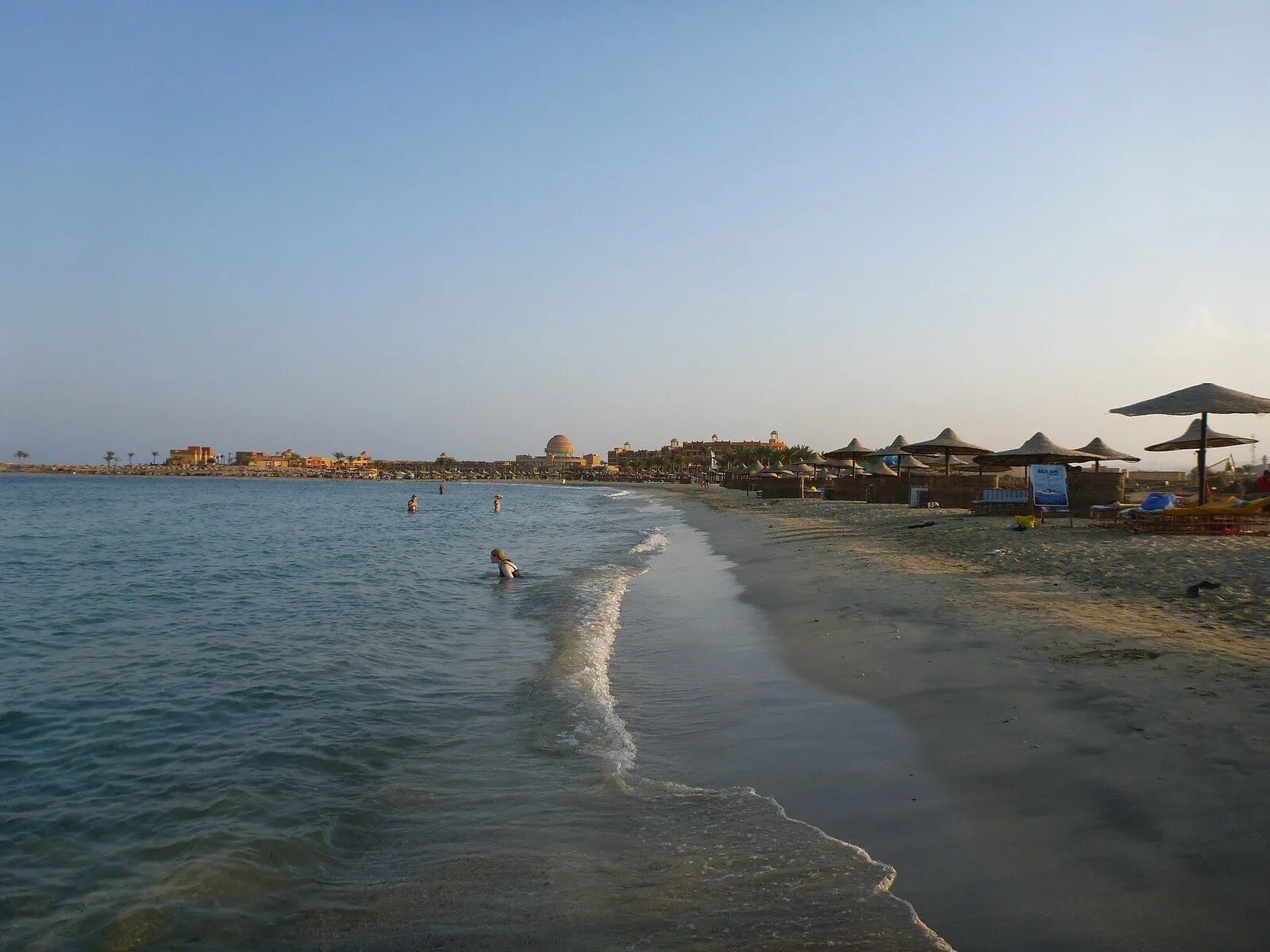
Photo credit: Wusel007 CC BY-SA 3.0 via Wikimedia
Please check the page to verify all specifics
Abu Dabbab Bay has one of the best sandy beaches in the Marsa Alam region but is deservedly better known as being one of the few places in the world where you can sometimes dive and swim with the endangered dugong “sea cow.”
There are two semi-permanent residents who are known by the nicknames of Dennis and Dougal. Two of only seven currently known to exist along the entire Egyptian Red Sea Coast.
And as if that wasn’t enough the bay is also host to hawksbill and giant green sea turtles (the latter typically 70-190kg), for whom the shallow waters and white sandy beaches serve as an invaluable nesting site, as well as the harmless guitar shark, amazingly colourful reefs, a myriad of beautiful fish, a small shipwreck and a swim-through canyon with underwater caves.

May 2020 – 4.32 mins – 97+ likes – 2,900+ views
You can just wade-in to the main bay and also explore the fringing reefs directly from the beach which makes it equally suitable to snorkelers and divers of all skill levels. The offshore reefs however are more suitable to divers and should only be visited with a professional guide.
Abu Dabbab beach is close to most of Marsa Alam’s hotels and located on a branch road off the main coastal road, between the Malikia and the Hilton Marsa Alam Nubian resorts, 34km north of the town of Marsa Alam and about 35km south of the airport and for those who like GPS coordinates you will find it at latitude 25’20’N and 34’45’ East.
You can usually find the entrance hidden behind a row of parked coaches and minibuses and behind it you will see the beach, often crowded with sun worshipers and snorkelers. But don’t let that put you off. It might not seem like the sort of wild place to find endangered exotic marine animals but fortunately and, despite the occasional crowds, it still is.

23.03.18 – 6m 58s – 503+ likes – 110K+ views
SPECIAL OFFER – ABU DABBAB TRIP
Ready for an unforgettable day at Abu Dabbab, the famous “home of the turtles”? Let Steven’s Taxis handle everything with this all-inclusive package—just €30 per person (minimum of three).
- Seamless Travel: Air-conditioned return transfers from all hotels between Marsa Alam town centre and Three Corners Sea Beach Resort (just north of Marsa Alam Airport)
- Unbeatable Value: The €30 price includes your transport and the €20 beach entrance fee—saving you money and hassle.
- Stay Refreshed: Enjoy unlimited soft drinks throughout the morning.
- Comfort and Shade: Relax on a free sun lounger, with the option of a sun umbrella for shade
- Snorkeling Made Easy: With a professional guide who can show you the best spots to see turtles, dugongs and coral reefs teeming with marine life.
- A Morning of Bliss: Your adventure starts at 8 am and concludes at 2 pm.
- Prefer different times? Contact Steven to discuss options.
- Prefer to go your own way? Transfers only (without entrance or extras) are also available from the same hotel zones for just €17 each way.
Book now! Steven at steven@marsaalam.com or contact him via WhatsApp on +20 102 999 9978 or by phone on +20 128 433 2337 to reserve your spot.
“Had a great half day there last year,” wrote Barry on Tripadvisor back in February 2011. “Calm conditions, spent ages just floating above a turtle, and was so relaxed I almost fell asleep.” More recently, Snixy from Bristol, was also delighted by his experience, remarking on Tripadvisor in April 2024 that
“The coral reef is, I would say, second to none – clarity and visibility in the water was incredible, and we could have stayed there all day. We were able to swim with a turtle, thanks to our guide who didn’t give up until he found one! And the fish on the reef are just mind blowing, it’s an aquatic Piccadilly Circus!”
In fact giant green sea turtles can be seen almost every day, as can the harmless guiltar sharks, although your chance of seeing Dennis or Dougal, the famous dugongs, vary from season to season (being slightly higher in the summer), and overall on any one day perhaps less than fifty-fifty. However many visitors have been lucky and some have even seen both dugongs on the same day !
The name “Abu Dabbab” can be translated as Father’s stepping stones. According to local mythology, many years ago when an earthquake struck it was because the gods were using the stones to cross the sea.

13.11.2022 – 16m 10s – 155+ likes – 3K+ views
SNORKELLING EXCURSION TO MARSA MUBARAK REEF
( CLOSE TO ABU DABBAB )
I can highly recommend Steven’s daily snorkelling boat trips which operate from Port Ghalib on a daily basis to both Shony Bay reef and Marsa Mubarak reef where you have a very good chance to see turtles and one of the best chances anywhere in the world (though not guaranteed) to see a dugong.
The trip is available every day and it leaves Port Ghalib Marina around 8.00 am and returns about 3.00 pm. The cost is just 40 euros per person which includes your return transfer if you are staying in a hotel within 30 km of Port Ghalib, ( a small surcharge applies to tourists staying at more distant hotels – please ask) as well all your snorkelling equipment, soft drinks, plenty of bottled water and a freshly prepared lunch.
YOU CAN SEE ‘BATFISH LIKE PSYCHADELIC DINNER PLATES.’
This is how a travel correspondent for The Times described diving at Marsa Mubarak – “While I wasn’t lucky enough to meet the whale shark which dropped by last week, or even the dugong or sea cow spotted by one couple, the reefs were teeming with life. Large octopus, muscular moray eels, blue-spotted stingrays, batfish like psychedelic dinnerplates and scowling grouper fish the size of well bred rottweilers put in obliging appearances, along with several giant sea turtles. It was like diving in an expensively stocked private aquarium. I half expected a smiling waiter in a white suit to come finning through the sea grass to ask if the reef was meeting my expectations.’
( ‘Egypt’s very own Private Aquarium,’ The Times, 23 February 2008, Travel supplement, p. 16. )
For more information or to book an excursion to Marsa Mubarak please contact Steven by email at steven@marsaalam.com or by WhatsApp on +20 102 999 9978 or by phone on +20 128 433 2337.

Jan 2021 – 1.46 mins – 98+ likes – 6,600+ views.
ABU DABBAB TAXI OFFER
As of 27 February 2026, Steven’s taxis is offering their lowest one way taxi fare from just 17 euro for a private air conditioned licensed taxi saloon (if your hotel is near the airport) or 26 euro (was 33) for a large airconditioned licensed minivan. For prices from more distant hotels email steven@marsaalam.com. You’ll also find an even better offer at 30 euro per person BUT which also covers your 20 euro entrance fee and much more besides posted near the top of this page.
Light meals and snacks are available at extra charge on the beach.
ABU DABBAB BEACH
As you enter via the south east corner of the beach you will need to pay (as of early 2026) a twenty euro per person (10 euro for children) entrance fee which is levied in order to prevent too many tourists overcrowding the bay. This fee also allows you free use of a comfortable sunbed and beach umbrella.
You will find toilets and showers available and the beach is kept very clean with a restaurant and two snack bars (Flouka Bar & the Reef Bar and Grill) where you can buy drinks and light meals including seafood, salads, pasta and pizza. Prices maybe high for Egypt but not excessively high for such a captive market, with (as of the last time we were able to check in late 2023) a pizza could be found at about 7 euros, a Greek salad at 8 euros, a beer at 5 euros and fish and chips at 13 euros – less than it usually costs at the cheaper London chippies.
Night owls will be disappointed to learn that we are no longer aware of the traditional Thursday night beach parties (which seem to have stopped around 2015) , but occasional parties may occur. For instance, in 2024 the Hilton Nubian posted on instagram informing followers that there would be one on 18 August to be held by the moonlit waters of Abu Dabbab Bay.
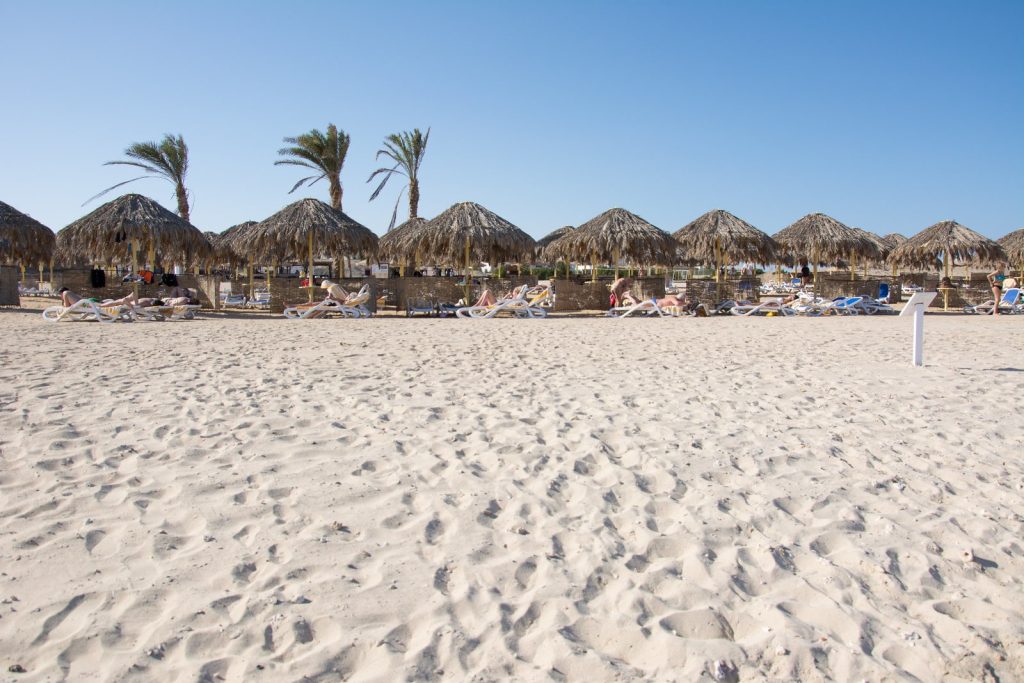
Photo: Crosa – CC BY 2.0 – via Flickr

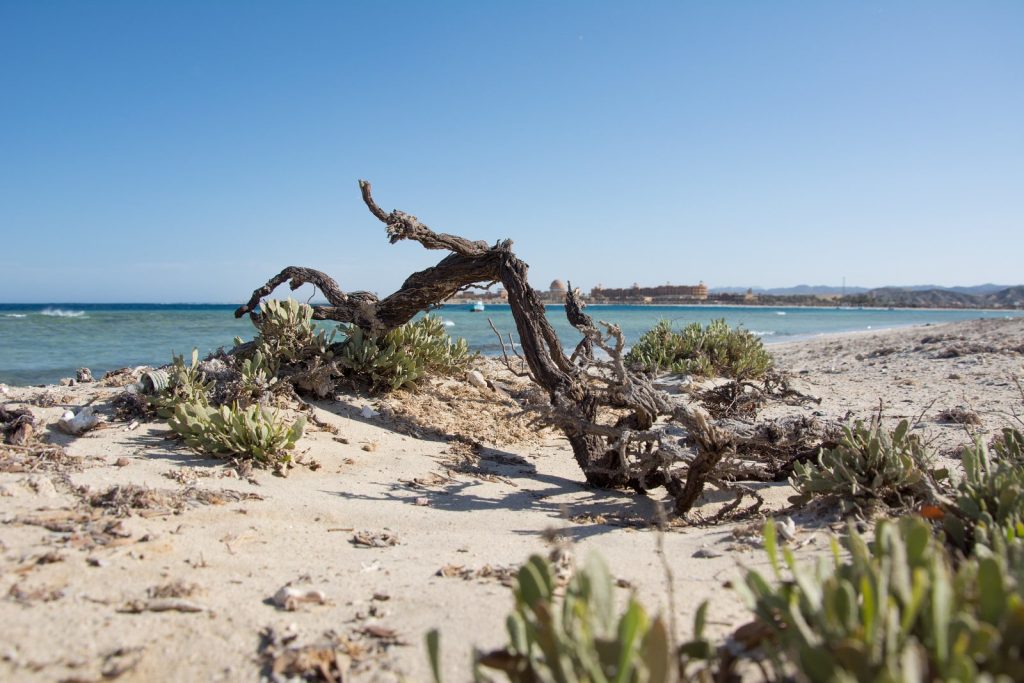
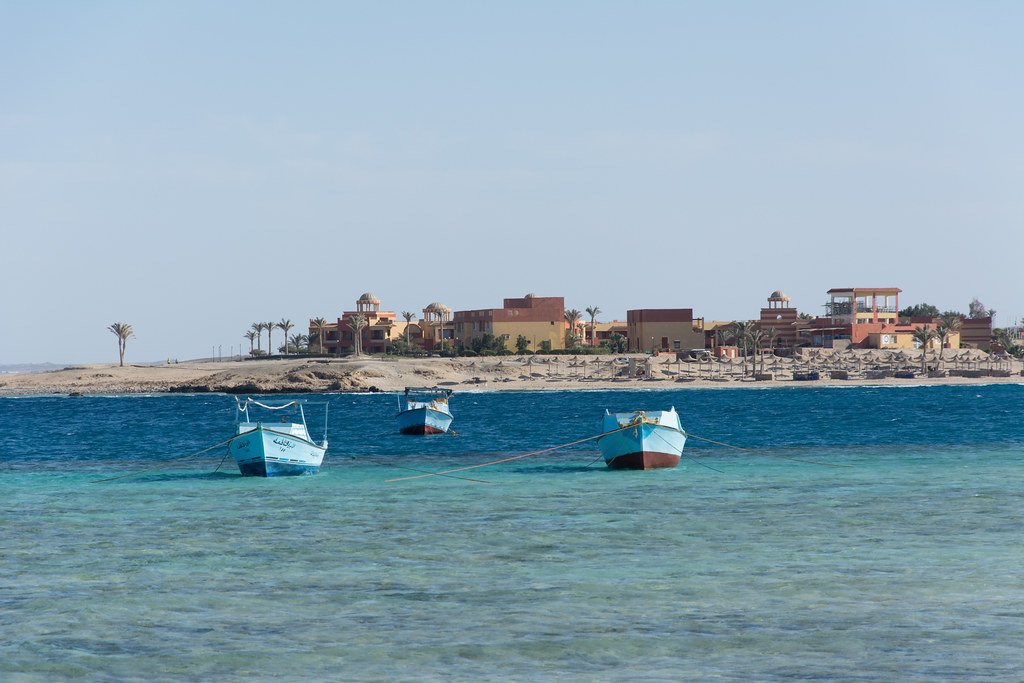
ABU DABBAB BAY AND REEFS
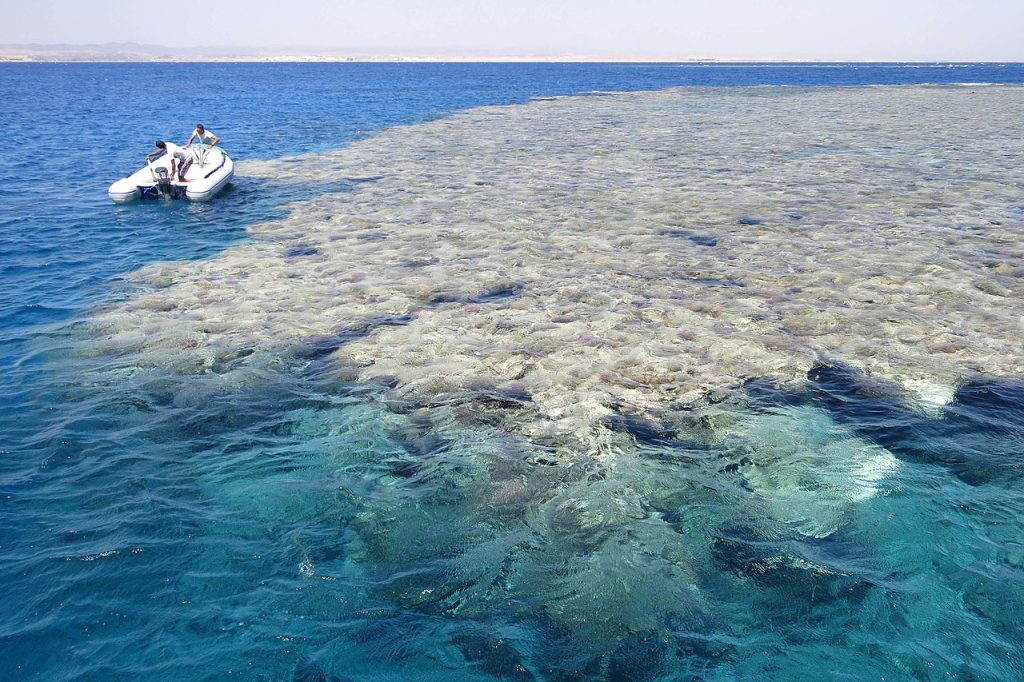
Abu Dabbab is a partially enclosed u-shaped bay with one of the best sandy beeches on its’ innermost western shoreline and one of the largest sandy bottom bays with seagrass in the region.
It is protected from the open sea on its’ northern and southern flanks by reefs which widen slightly near the Eastern mouth of the bay. The bay is therefore fairly sheltered and it’s depth descends slowly as you progress further towards the sea but typically averages 15 metres.
However East of the bay mouth and the fringing reefs, there is a steep drop off descending to around 30 to 40 metres. Also you should note that due to the sandy bottom within the bay, visibility is not always good with typical visibility at between four to ten metres in average conditions.
To overcome this visibility problem divers or snorkelers can advance line abreast, three to four metres apart and when one spots anything point the others in their direction. However care should be taken that this is not done in such a way which will intimidate the turtles or the dugongs.
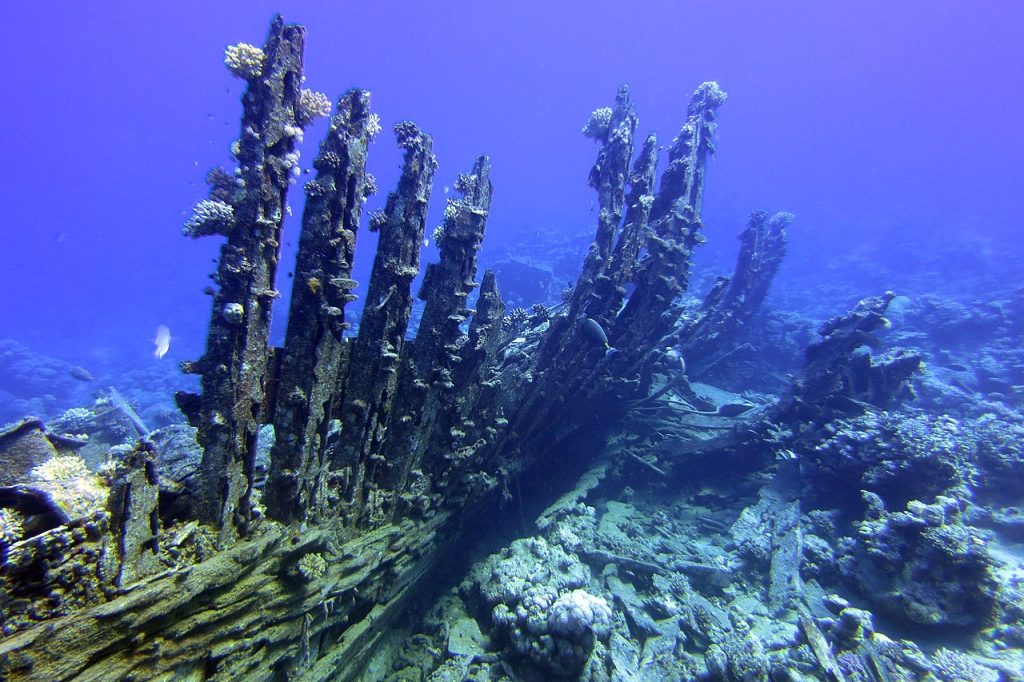
A few minutes by zodiac out to sea you can also find offshore reefs, where divers can explore a small shipwreck dating to 2004 when a liveaboard boat, Heaven One, sank in 15 metres of water, with its’ engines and many fitments still visible though heavily damaged by the fire and subsequent sinking.
And lying a similar short distance to the south, lies a spectacular swim through canyon system with occasional tunnel sections and an amazing coral garden although there are reports of strong currents here. The reefs off Abu Dabbab are known collectively as sha’ab Abu Dabbab and numbered individually from 1 to 7.
Futher out to sea, approximately 7km to the East of the bay, lies Elphinstone reef famed for both the variety of marine life and the frequent visits by oceanic whitetip sharks. For more about this reef read the Elphinstone Reef page.

07.05.16 – 10m 32s – 239+ likes – 41K+ views

Feb 2019 – 6.16 mins – 32+ likes – 2,200+ views
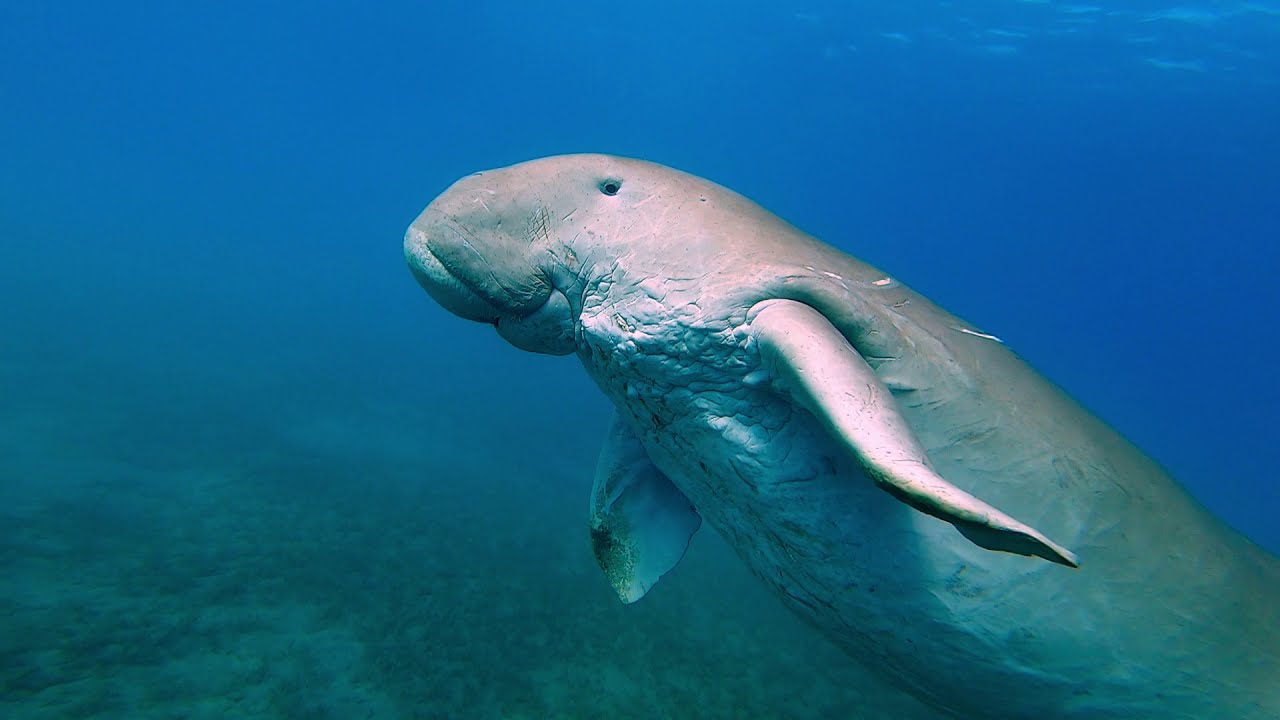
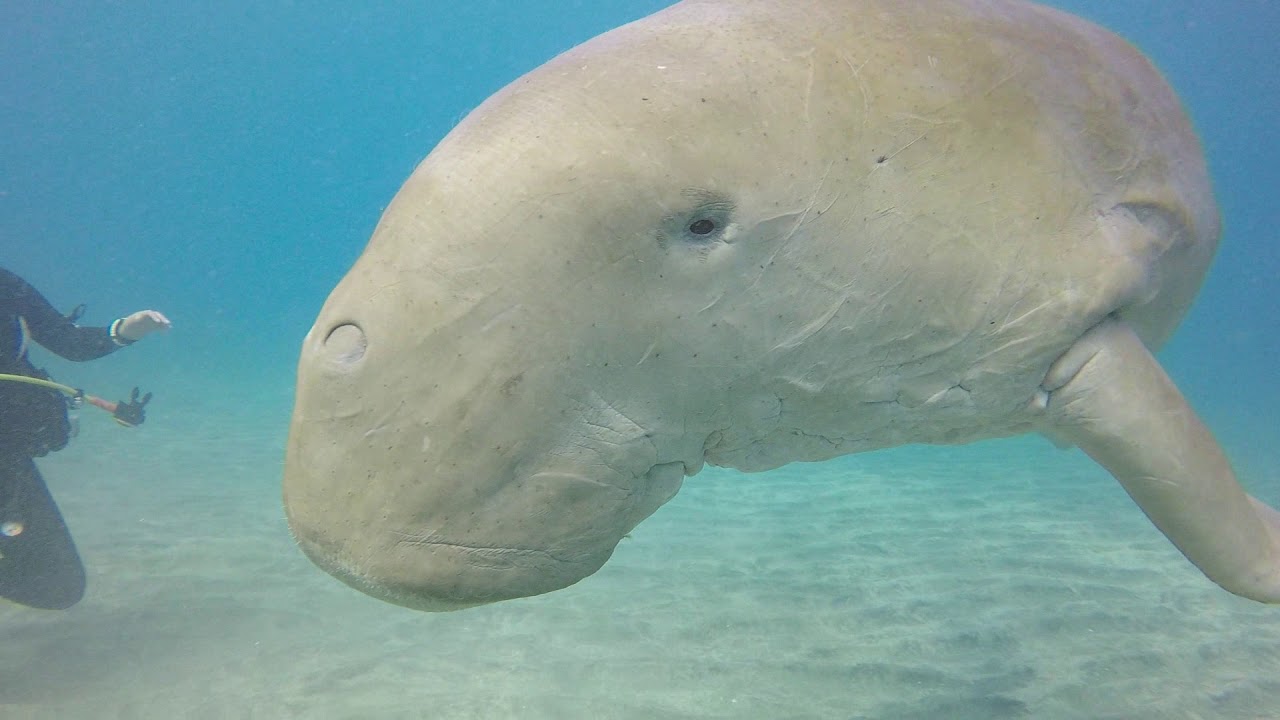
ABU DABBAB’S DUGONGS
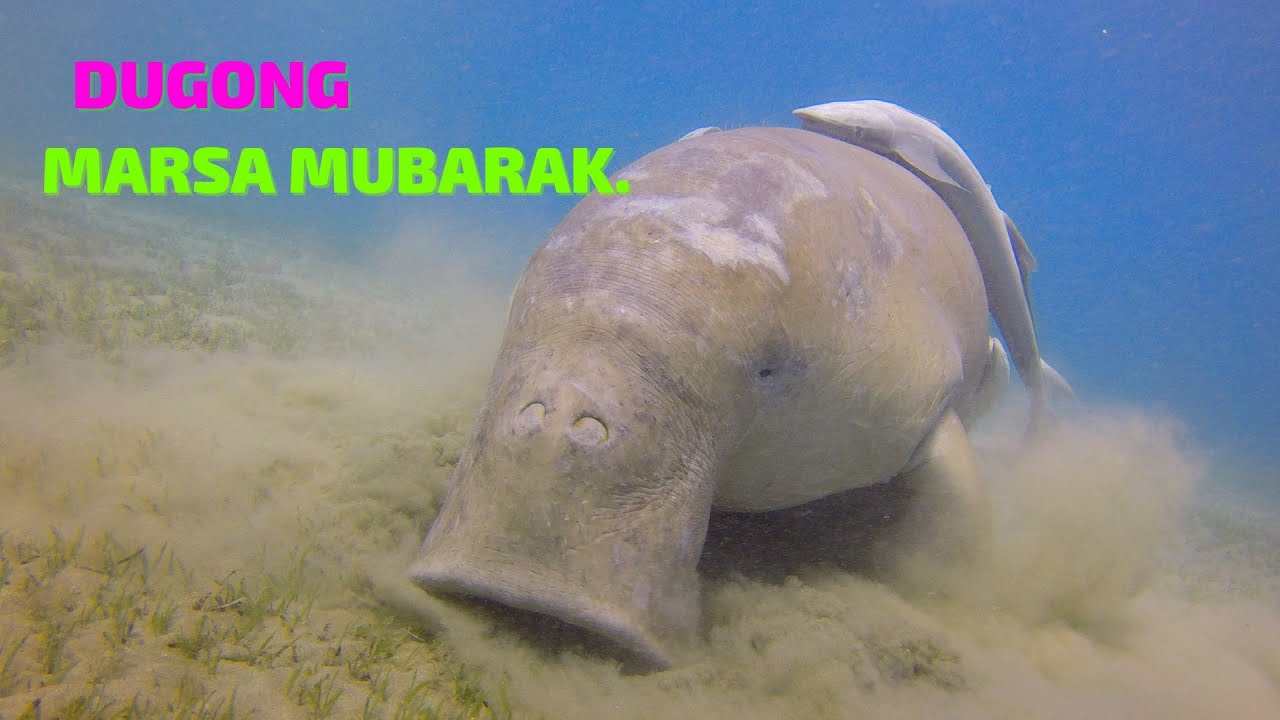
The most famous resident marine animals are the two dugongs but seeing either of them is usually a matter of chance. However if you are on a beach do keep an eye on the snorkelers as you can usually spot the excitement when a dugong is detected. However do not rush in so quickly that you and others will intimidate the animal which will force it to disappear quickly into the depths.
You will be surpised how quickly the dugong swims for although Egyptian dugongs can weigh up to 500kg and swim at an average speed of 10km/hour they are capable of bursts of speed of up to 20km/hour.
Dugongs are sometimes tolerant of the occasional swimmer at near distance but they don’t seem to enjoy crowds of overly curious onlookers. An Italian diver Roberto Sozzani describes how one Dugong at Abu Dabbab soon found all the attention too much.
“…..In order to avoid the wild crowd on the surface, the dugong dove and then emerged covering long diagonals, moving to deeper and deeper waters. But he was inevitably reached each time she surfaced while countless hands came forward trying to touch her. The result was that he left the bay after only a few minutes.”
( approximate translation from the Italian – RobertoSozzani.it )
He was left feeling despondent about the bay’s suitability as a place of sanctuary, declaring his belief that “business has had the upper hand, they have built a ‘circus’ around this dugong,” adding that “if before I hoped that he could find security and tranquility in the calm waters of Marsa Abu Dabbab, now I hope that he will soon find a new Marsa, isolated, without a beach, far from that human presence that does not know how to respect nature.”
However, dugongs, whether out of habit or resilience, continue to visit and if you get a chance to watch the dugong feeding on the grassy sea bed, the sight is amazing for as she grazes the animal expels a huge cloud of fine sand particles and every few minutes emerges to take a few breaths at the surface before returning. But please please don’t touch the animal and try to keep your distance!
For such a huge animal, with an enormous seal like body and paddle-like foreflippers, the dugong is surprisingly quiet and has no natural defence against predators except for its’ hug size. The Egyptians dugong can grow up to 2.5 or even 3 metres long and has a average lifespan of around thirty years.
The last scientific study of dugongs along Egypt’s Red Sea Coast was by Professor Dr Mahmoud Hanafy in 2001 to 2003, who identified between 12 and 17 individual dugongs each year. He noted that more were seen during the summer which was possibly due to a winter migration of some dugongs to warmer water.
Unfortunately this beautiful animal is classified as a “vulnerable to extinction” and it is has sadly earned a place on the World Conservation Union Red List of Threatened Species.
Its’ worldwide population is in decline. It has already disappeared altogether from the Maldive Islands, Mauritius and Taiwan and while there is still a significant population around the Australian coastline, they exist in only very small numbers in the Red Sea.
The sea grass meadows, which they depend on, are highly sensitive to human interference especially to any fertilizer run off from coastal resorts and dredging – both of which can prevent light from reaching the sea grass and thereby limit its’ growth.
For more fascinating and quirky facts about the dugong please visit our dugong page.

13.08.20 – 2.23 mins – 11+ likes – 48+ views

Nov 2020 – 2.12 mins – 11+ likes – 260+ views.
Jan 2021 – 1.08 mins – 1+ likes – 11+ views.
Oct 2018 – 4.18 mins – 32+ likes – 2,600+ views.
TURTLES
Despite being classified as critically endangered by the International Union for the Conservation of Nature’ (IUCN), you have a very good chance of being able to see the Hawksbill sea turtle as well as other sea turtle species while at Abu Dabbab. They seem fairly oblivious to the presence of divers or snorkelers.
“If you got too close with your camera, you simply received a gentle push from their flippers,” remarked one diver on divernet.com.
When you see sea turtles at Abu Dabbab you will often also spot an accompanying Remora fish feeding of the parasites on the turtle’s shell.

Feb 2016 – 2.08 mins – 17+ likes – 1,200+ views
OTHER MARINE ANIMALS AND FISH
You will also quite often see titan triggerfish, brilliant green pufferfish, triangular trunkfish, trevallies, occasional giant barracuda and fast moving guitar rays as well as harmless guitar sharks.
Along the fringing reefs you might also sometimes spot sea scorpions and stone fishes as well as large stingrays and as you reach deeper waters expect any types of surprise. Even a giant whale shark was recently spotted.
CAUTION WHEN APPROACHING BY BOAT
The reefs to the south and east of this bay necessitate a cautious approach from the North staying well clear of the coastal reef. You are not allowed to enter the bay itself which is marked off by buoys. Please however don’t rely on any advice you read here – you should study the relevant charts.

01.10.2023 – 11m 6s – 9,500+ views
ENVIRONMENTAL CODE FOR ABU DABBAB
- Please keep at least two metres distance from any turtle or dugong at all times and never touch them. This is also in compliance with Egyptian Law no 102 of 1983. You will see signs along the beach reminding you of this rule.
- Motorized boats are not allowed access inside the bay. Moorings were removed in 2007 to prevent overnight stays by safari boats and you will see a lign of buoys demarcating the “no boat” bay area from the open sea.
- Access from the shore is restricted in terms of numbers. Don’t worry about this as your guide or a ranger will notify you in case of any problem but under normal circumstances this is not an issue.

Jan 2021 – 3.17 mins – 23+ likes – 550+ views.
WIDER ENVIRONMENTAL ISSUES
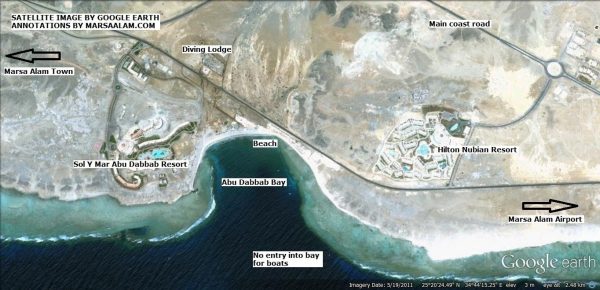
The number of hotel beds in the immediate vicinity continues to grow and there is concern as to how many tourists this small coastal strip can sustain in the longer term. There were also plans to create a marina with inland lagoons and if this ever goes ahead it could potentially pose a serious threat to the bay’s environment and vulnerable ecosystem.
Even as it is, the huge number of visitors and divers and the failure to follow guidelines means that sea turtles and dugongs are sometimes injured or killed by boat propeller strikes, and endangered marine life may be permanently scared away from the important seagrass and nearby coral reefs by the constant close proximity of snorkellers and divers.
Plastic waste also remains a major concern and threat to marine life in the area. With this in mind recycling bins have been prominently located on the beach and notices remind tourists not to drop any litter. There have been periodic attempts, such as the #plasticfreejuly campaign in 2019, by locally organised groups to clean Abu Dabbab of plastic, cigarettes and other waste, and in general the beach remains litter free.
There is also however the question of how well successive Egyptian governments have regulated the environmental impact of hotels and other economic operations in Abu Dabbab and the wider Marsa Alam area.
According to a study by Amir Gohar and G. Mathias Kondolf of the University of Berkeley California, entitled “How eco is eco tourism?“, a small minority of resorts in the Marsa Alam region may have been constructed partially or completely on top of natural saltmarsh land sometimes with the use of landfill, both posing a potential habitat loss and flash flood risk.
There have also been environmental risks posed from outside the tourism sector. In 2002, a joint mining project was initiated with a proposed tantalum mine located some 16 or 17 km inland from Abu Dabbab, although it also had a planned additional plant site which was only about 6 km inland.
The Australian based Gippsland and the Egyptian state owned Egyptian Company for Mineral Resources (ECMR) teamed up to form Tantalum Egypt J.S.C. with a plan to open a mine that would have produced a quarter of the world’s supply of tantalum as well as becoming the world’s largest tantalum mine, a strategic rare earth metal used in the chemical industry, electrical circuit capacitators, computers, mobile phones and aircraft engines.
The main environmental concerns were how the waste materials would be dealt with and the theoretical very low level radioactivity of any tailings and waste materials that might contain thorium and uranium as well as the impact of any necessary infrastructure and transportation. Gippsland announced in 2010 that a “detailed environmental assessment impact (EAI)” had “been completed to world bank standards,” but if this is accessible online, I haven’t yet been able to find it.
[ I was however able to find a study, published in December 2018, on radioactivity levels of “rare metals-bearing albite granite” in the nearby or possibly same area of Jebel Abu Dabbab, which reassuringly reported that “all values of the radiation hazard indices in the studied samples of Abu Dabbab mining area are under the health hazard limits.”
Heikal et al., J Environ Hazard 2018 ]
Initial preparatory works for the mining operations started and a plan was originally submitted to locate a seawater intake pipeline approximately 3 kilometres to the north of the bay (to transport an estimated 18,000 m3 of seawater daily from the coast to the mine) and to establish a new ship loading facility in the same location, both plans obviously involving a significant environmental impact. The company also began to erect a “private free zone security fence” around the site.
In 2015, however, the Egyptian government, revoked the license. I could not determine whether this is because the Egyptian government believed the Australian company was financially inefficient, whether they were concerned about the schedule, whether they simply wanted to oust the company (as allegedly believed by the chairman of Gippsland subsidiary Tantalum International Mining), or whether it was due to any possible concerns regarding potential environmental damage, but in 2019 Gippsland (under its subsidiary Tantalum International Mining (TIM) and rebranded Emerge Gaming Limited names) sued Egypt at the International Centre for Investment Disputes reaching a cash settlement in 2021.
I can’t find any settlement figure mentioned, so I assume there might have been a confidentiality agreement, but according to journalist Paul Sakkal writing in the Sydney Morning Herald in 2019, Egypt was facing damages which could have amounted to “potentially hundreds of millions of dollars.”
According to the Chairman of TIM, the 2021 settlement reflected “a renewed commitment to the fair treatment of foreign investors,” although, if the mining operation project might now hopefully have been abandoned, environmentalists might question whether Egypt had to pay for daring to take action which would (regardless of whether or not this was the actual reason stated by the government) protect its environment from any possible risk the mining operations as planned might have posed.
Reassuringly, as of February 2026, viewing Google Earth satellite images dated mostly September 2023 (but with some data being of unknown date), while being able to see extensive evidence of excavation and rock removal and buildings at various sites (some or which may have been the work of earlier twentieth century mining projects) in the wadis and mountains to the west of Abu Dabbab, I didn’t notice any sign of even a single lorry or excavator or other large vehicle and while it’s possible I missed something, it seems that there might not be any current mining activity, but due to the paucity of data and the vast area it’s difficult to be 100% certain.

21.09.2024 – 8m 25s – 6+ likes – 1k+ views

14.02.2020 – 1m 45s – 4+ likes – 200+ views

Photo – Matt Kiefer – CC BY-SA 2.0 – Flickr
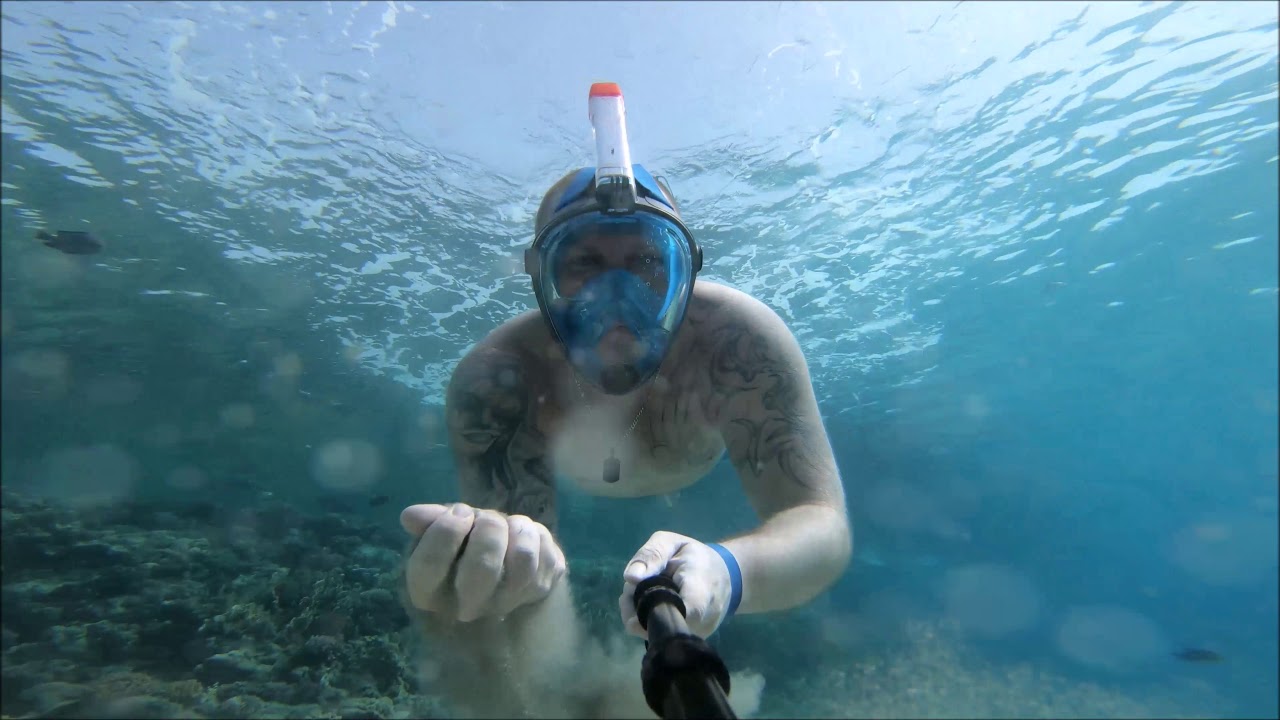
June 2018 – 28m 30s – 128+ likes – 23K+ views

29.08.2024 – 4m 5s – 90+ views.
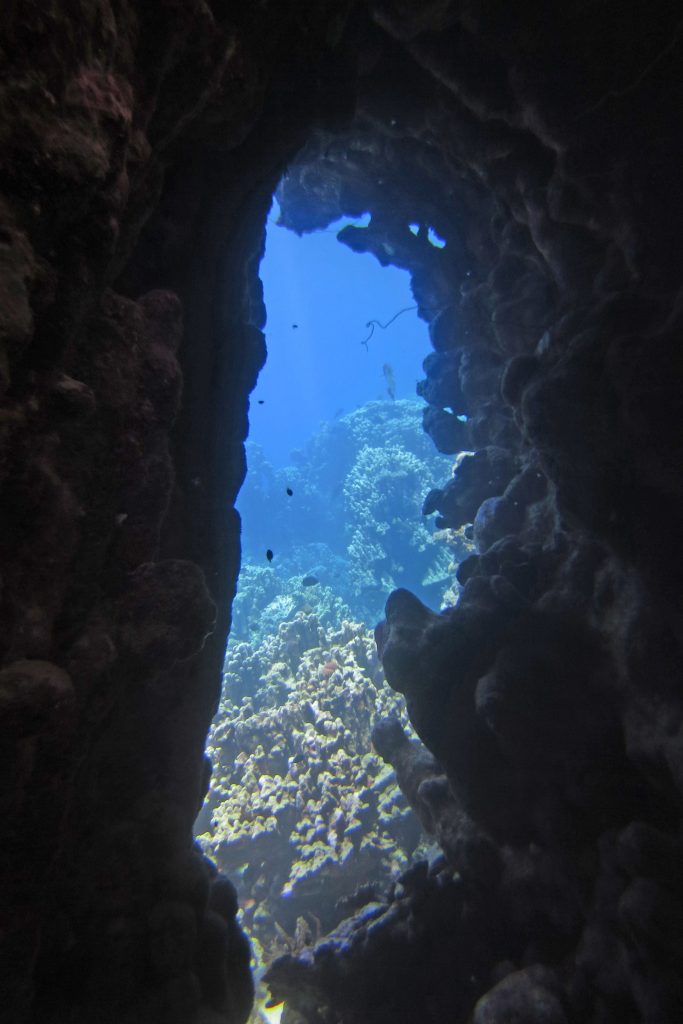
Roland Unger – CC BY-SA 4.0 – via Wikimedia
MORE ABU DABBAB PHOTOS

Photo: Gigi Ibrahim – CC BY 2.0 – via Flickr

wusel007 – CC BY-SA 3.0 – via Wikimedia Commons

Photo: Ruth Hartnup – CC BY 2.0 – via Flickr

Photo: Crosa – CC BY 2.0 – via Flickr

You can see interesting seashells on the beach
Photo: Crosa – CC BY 2.0 – via Flickr
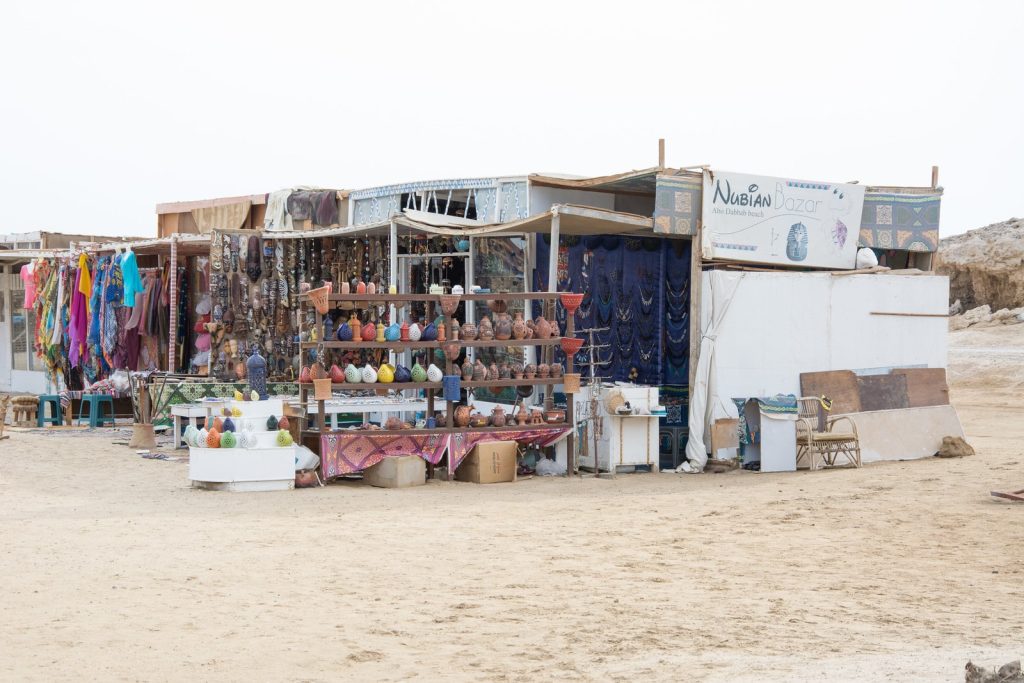
Photo: Crosa – CC BY 2.0 – via Flickr.
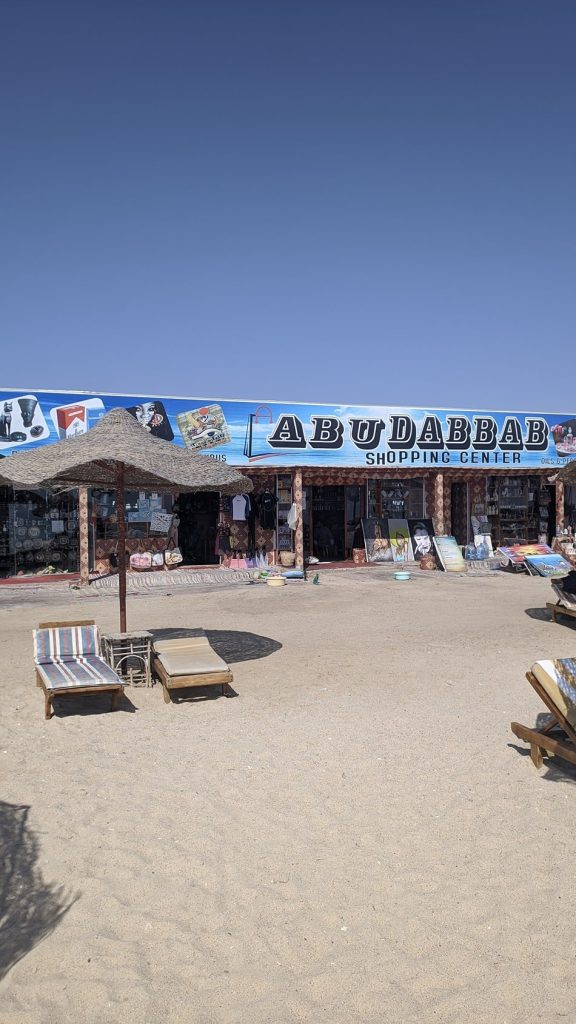
Fenikals – CC0 1.0 – via Wikimedia

Photo: Hossam el-Hamalawy – via Flickr

Photo: Dominic Scaglioni – CC BY 2.0 – via Flickr

Photo: Crosa – CC BY 2.0 – via Flickr

Photo: Crosa – CC BY 2.0 – via Flickr
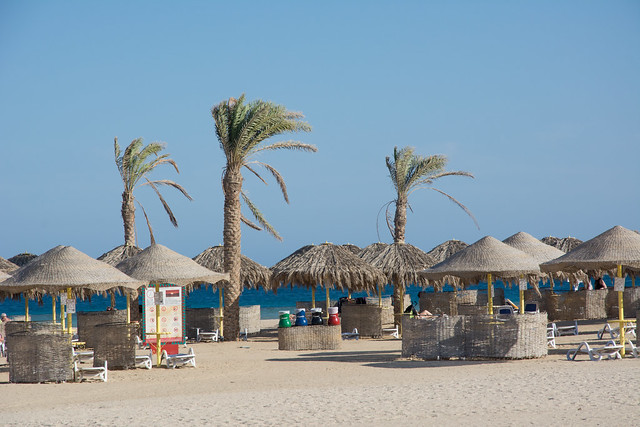
Photo Crosa – CC BY 2.0 – via Flickr

Photo Wusel997 – CC BY-SA 3.0 – via Wikimedia
Roland Unger – CC BY-SA 4.0 – via Wikimedia
Roland Unger – CC BY-SA 4.0 – via Wikimedia.
For more Abu Dabbab photos
ABU DABBAB SATELLITE IMAGES IN 2018 (TOP) COMPARED WITH 2011 (SECOND IMAGE DOWN) AND 2004 (LAST IMAGE) SHOW THE EXTENT OF RECENT HOTEL DEVELOPMENT CLOSE TO THE BAY
2018

2011
2004