BIRDS OF EGYPT’S RED SEA COAST AND EASTERN DESERT
All locations given are approximate and should not be relied on for navigation.
Detailed guides to 22 birds listed alphabetically
On mobile: use fingers to zoom any image
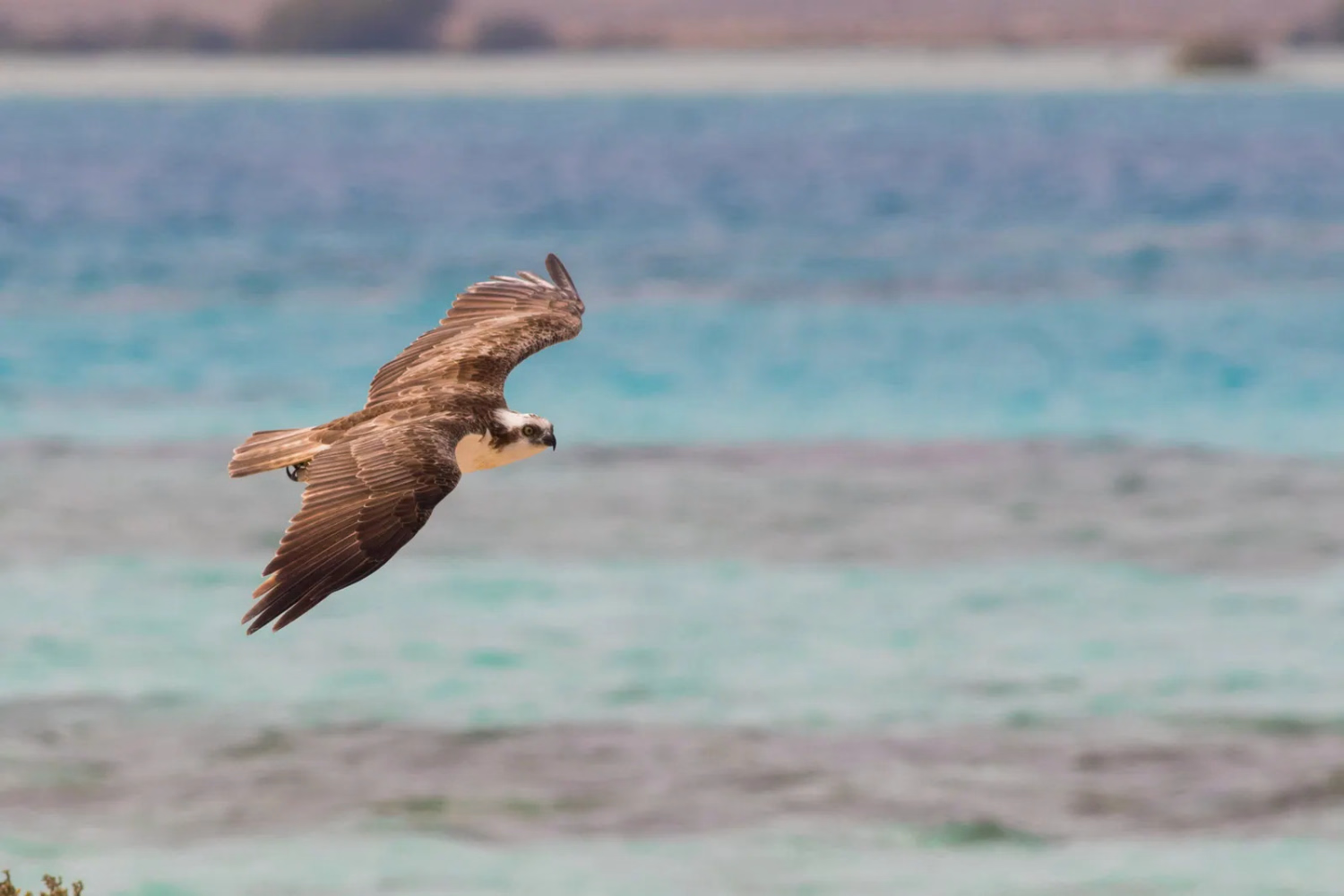
Photo credit: Ahmed Waheed/Shutterstock
Egypt’s Red Sea coast not only provides unique habitats for many native birds but also strategic stopping off points for European and central Asian migrant birds on their way to or returning from their wintering grounds in the tropics of Africa and south Asia. Although for many years, the wetlands of the River Nile, the Delta, Lake Nasser and their fringes may have attracted the greatest attention from bird watchers, the Red Sea coast, its islands and desert hinterland are offering increasingly exciting alternatives.
Not only does the region’s mangroves, mudflats, mountain wadis and offshore islands offer surprisingly biodiverse habitats, but the spread of tourism and hotels with their extensive cultivated gardens along Egypt’s Red Sea coast offers convenient resting and feeding points for birds as well as humans, providing the perfect opportunity for visitors to take up some bird watching or bird photography.
Here is a list of twenty two birds you might come across, along with some stunning photographs by some great photographers, most of them taken on or close to Egypt’s Red Sea coast. I have whenever possible made a reference to each bird’s distinctive features regarding size, shape and colour, as well as describing its usual feeding behaviour, other interesting facts and not forgetting what every visitor wants to know – the most likely times and places in Egypt to spot it.
The Black Bush Robin
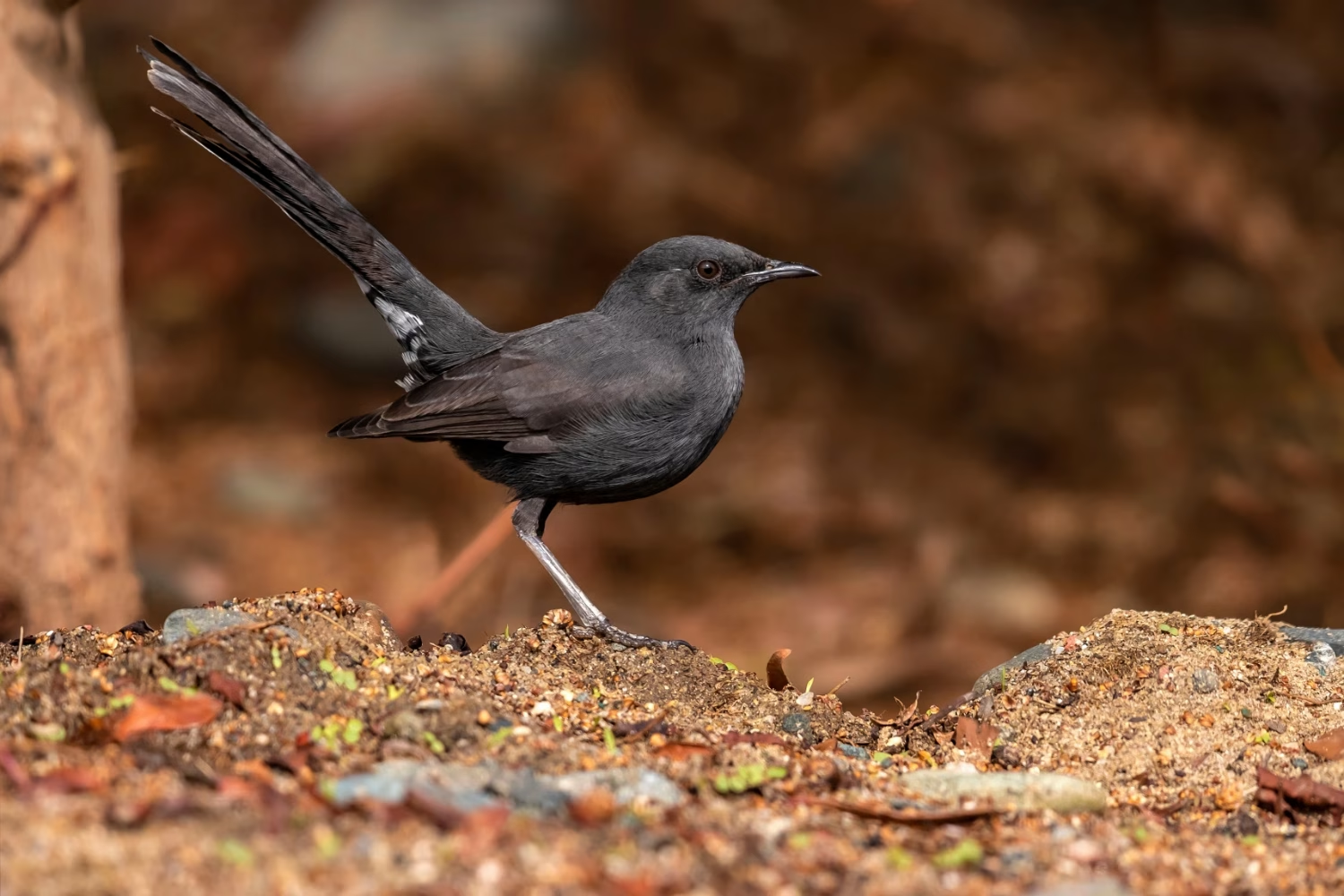
Scientific name: Cercotrichas podobe – Arabic name: Abu hanaa’ al ahrash al aswad أبو حناء الأحراش الأسود
The Black Bush (or Scrub) Robin is considered resident through much of western and southern Arabia as well as sub Saharan Africa from Guinea in the west to Eritrea in the east. However it regularly ventures northwards during the spring and summer and appears to be particularly attracted to hotel grounds along Egypt’s Red Sea coast, although it also frequently migrates as far north as Israel. According to a 2013 article on the Black Bush Robin by Josh Jones in Bird Guides, it had already been spotted by bird enthusiasts at Shams Alam Resort, about 52 km south of the town of Marsa Alam.
Jones had himself stayed at Lahami Bay, which lies approximately 122 km south of Marsa Alam, where he had been “overawed by the number and variety of migrants using the spot as a stopover.” Beneath a photograph he had taken of a Collared Pratincole taking a drink at the hotel’s swimming pool, he wondered “Surely it won’t be long before Black Bush Robin is found here?” Well, he was right to feel optimistic, since the photograph above was taken at that very same resort!
According to the USAID online factsheet “Where to watch birds in Wadi el-Gemal National Park and Neighboring Areas?,” besides Shams Alam Resort and Lahami Bay, the Black Bush Robin has also been seen at El Gouna (just north of Hurghada), Shalateen and Gebel Elba.[1] The first ever recorded sighting of the bird in Egypt dates back to 1869 when it was seen 200 km south of Marsa Alam in what is now the Gebel Elba National Park.[2]
The Black Bush Robin feeds on insects and prefers areas of undergrowth or the shadow of acacia trees, which probably explains why it might be attracted both to mountain wadis along Egypt’s Red Sea coast as well as to the well tended gardens and bushes of Red Sea resorts. On the IUCN Red List for birds it is categorised as being of “Least Conern.” If you want to know what it sounds like there are several recordings of the bird on ebird.org. The total length of an adult is approximately 20 cm (8 inches) and it weighs approximately 24 to 27 grams, according to oiseaux.net.
The Bluethroat

Photo credit: Neil Bowman/Shutterstock.com
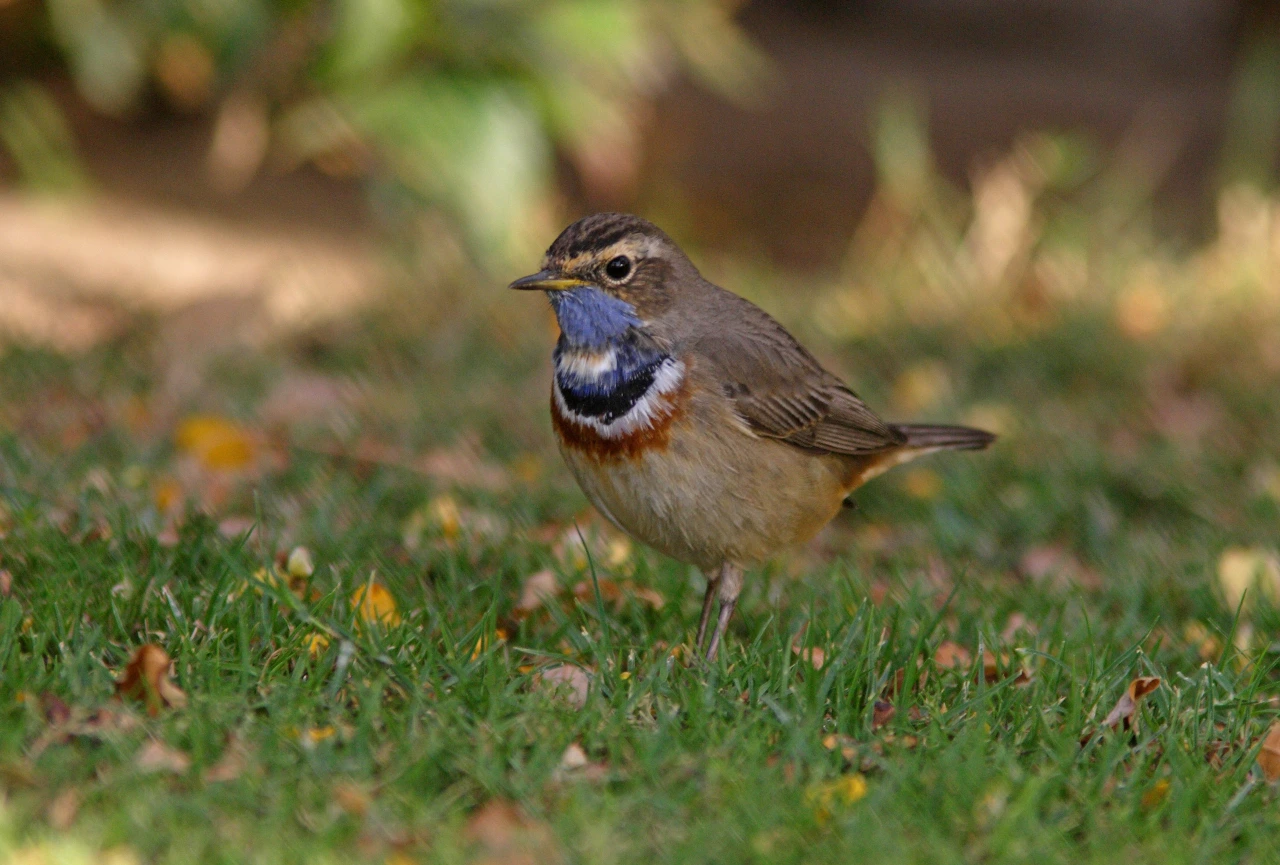
Photo credit: Neil Bowman/Shutterstock.com
Scientific name: Luscinia svecica – Arabic name: Husaynee حسيني
The bluethroat is similar in size to other robin-like birds, about 13 to 14 cm long, displaying (except for some females) an unmistakable bright blue throat in spring. It has a wide and varied habitat across sub-Saharan Africa, North Africa, the Middle East, Europe, Asia and Alaska. Within Egypt, however, its usual habitat is either along the Nile and its Delta or the Red Sea coast (ebird.org).
The two photographs above were both taken at the Red Sea resort of Sharm El Sheikh. You are most likely to see it there or at other Red Sea resorts if holidaying during the winter months anytime between early October and mid April, although there are reports of it being seen as early as 18 September and as late as 4 May.[3]
It nests in thick tussocks of grass or dense bush and prefers to spend much of its time in overgrown fields, dense vegetation, thickets or other scrubby or brushy habitats. The UK’s Royal Society for the Protection of Birds (RSPB) notes that they can be elusive and difficult to spot, but provides a two minute recording of what the bird sounds like.
Ebird.org comments that “females show fainter colors than males, sometimes lacking blue entirely, but are still very boldly patterned.” However, they are still not difficult to recognise. Richard Porter in “Birds of Egypt” suggests you can still easily identify females and males in summer by watching out for “the reddish colour at the sides of the tailbase, the white strip above the eye, and the black necklace.”[4]
The Cattle Egret
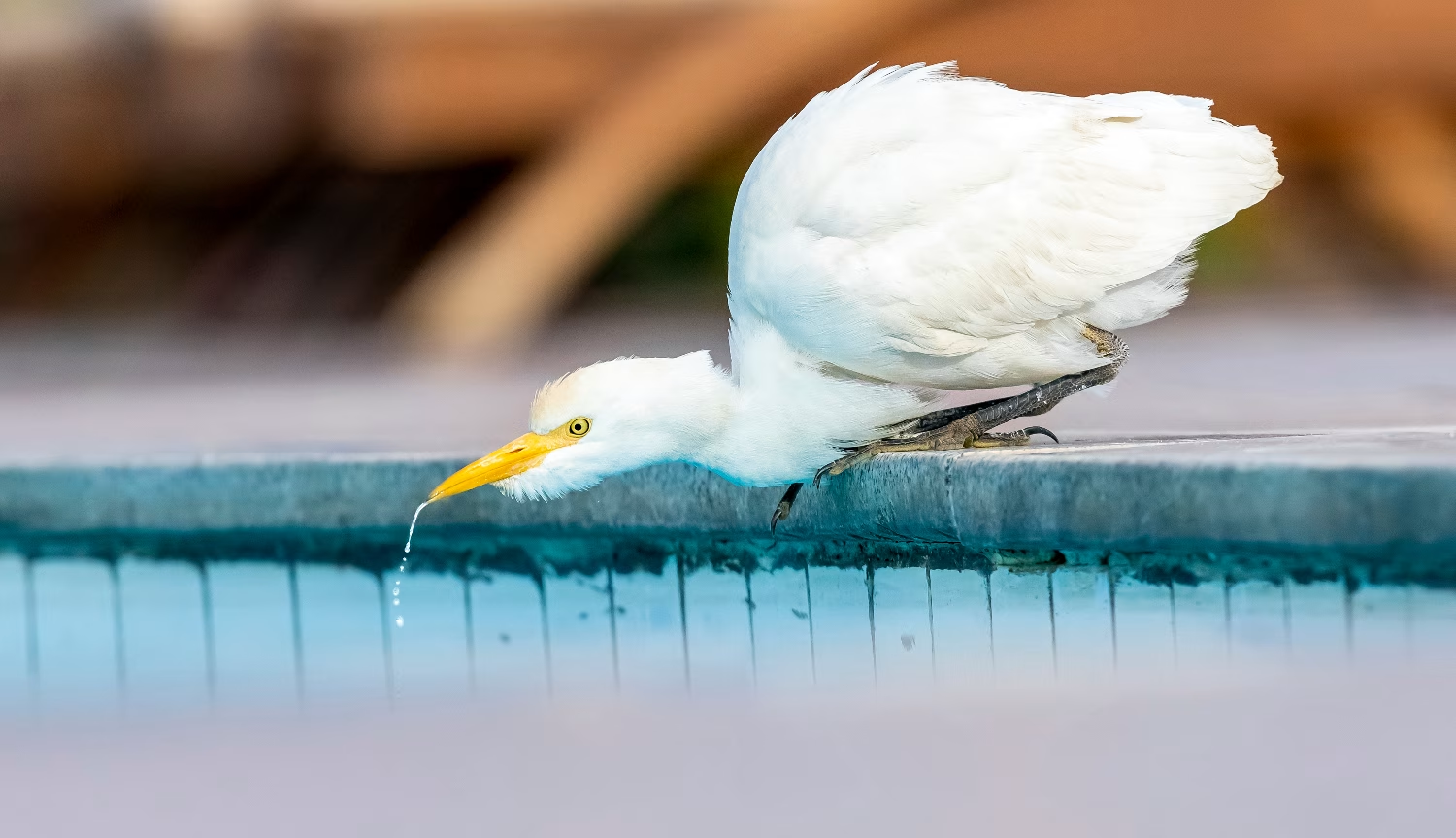
Scientific name: Bubulcus ibis – Arabic name: Abuu qurdaan أبو قردان
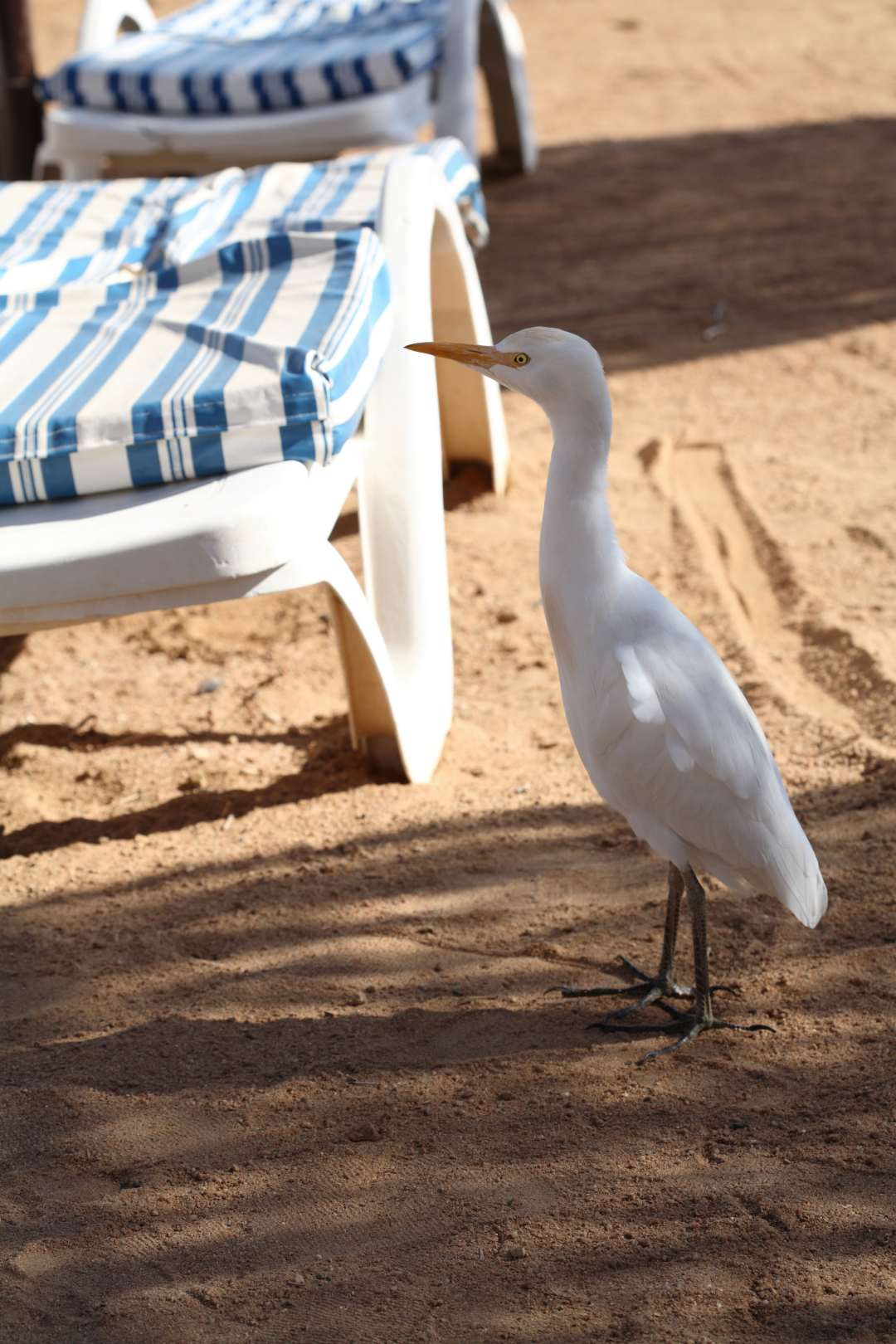
The cattle egret is one of the most commonly seen birds within the grounds and gardens of Red Sea resorts and is usually relatively unconcerned about the presence of tourists, as you can see from the photograph above of one drinking at the swimming pool of Shams Alam Resort (located some 52 km south of Marsa Alam). You will also come across them frequently almost anywhere along the Nile Valley and even at the oases of Kharga and Dhakla in the Western Desert.
It’s difficult to imagine that this endearing bird that struts so self confidently across the flower beds, lawns and beaches of tourist resorts was once almost extinct within Egypt in the early twentieth century due to the appetite of European plume hunters. Thankfully, in 1912, Egypt’s government passed a decree (Law 9 of 1912), which outlawed the hunting of 39 species of bird considered advantageous to agriculture. The cattle egret has traditionally been known in Egypt as the farmer’s friend as it targets insects and worms. Another factor in its favour is that it is also considered bad luck to kill one.[5]
The cattle egret is not so common in the Delta as in the Nile Valley, due possibly to the more extensive use of pesticides in the Delta area. Luckily their numbers still remain high elsewhere and they are often seen as far south as Lake Nasser and Abu Simbel, and along the Nile Valley, roosting sites containing hundreds and sometimes thousands of birds have been observed. One of the largest recorded being south of Sohag, in 1984, which was then home to over eight thousand birds.[6]
The cattle egret is typically about 45 to 50 cm long, with a wingspan of around 82 to 95 cm and a weight of approximately 300 to 400 grams.(RSPB) While its global habitat was originally confined to parts of the Mediterranean and North Africa, as well as tropical and subtropical Africa and Asia, over the last 150 years it has successfully colonised large parts of the Americas and Europe as well, first arriving in the United Kingdom as recently as 2008 where it is now often seen in large flocks of 100 or more.[7]
It is thought that the population globally may be increasing and so it falls into the IUCN category of “least concern.”[8]
ID 110410812 | © Alesse | Dreamstime.com
The Crowned Sandgrouse
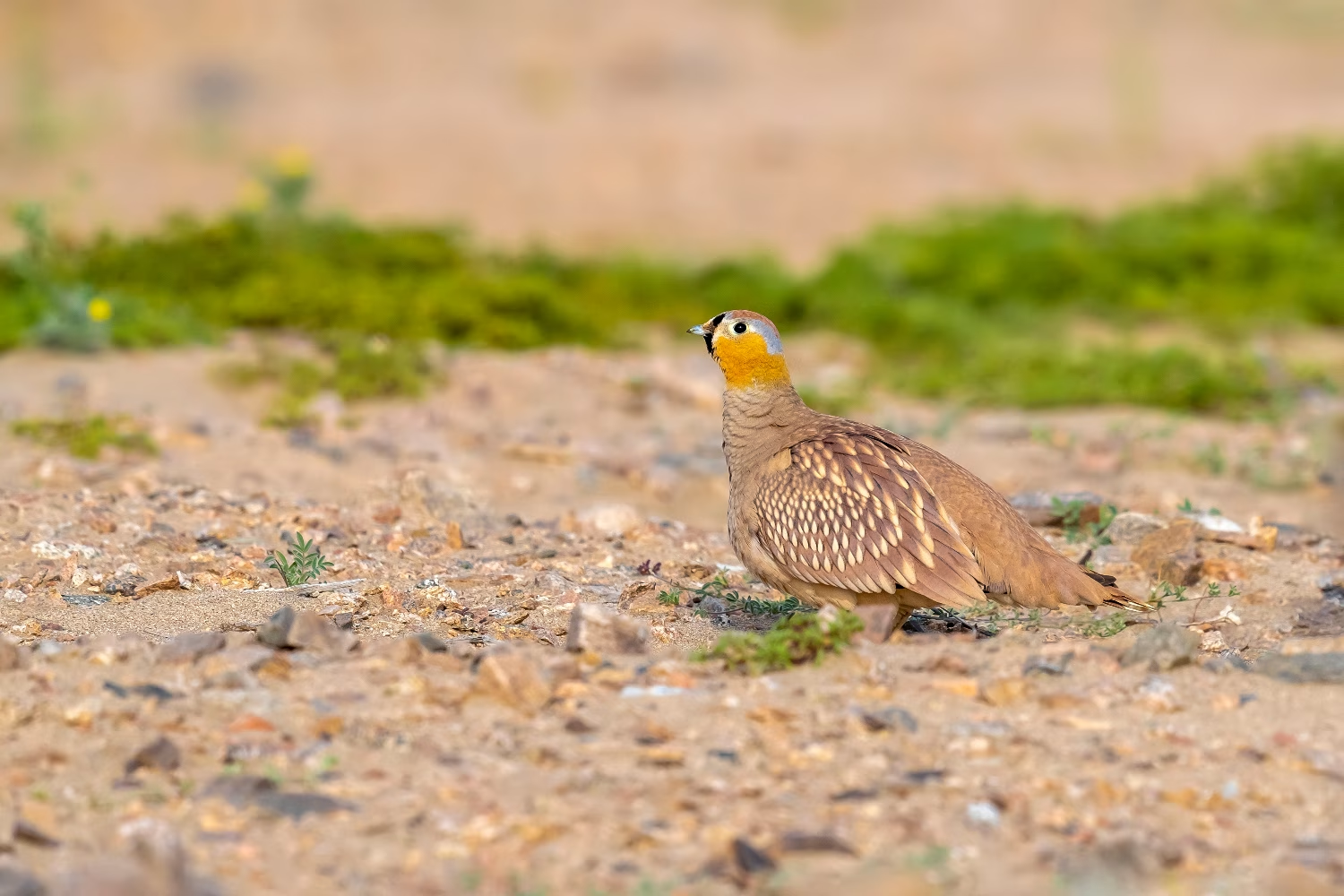
Photo: Agamic Photo Agency/Shutterstock.com
Scientific name: pterocles coronatus – Arabic name: qataa mutawwaj قطا متوج
The crowned sandgrouse can often be seen in the Sinai peninsular as well as Egypt’s Eastern Desert and particularly in semi-desert areas such as the mountain valleys of Jebel Elba or the Wadi El Gemal National Park. The photograph above was taken somewhere in Egypt’s Eastern Desert not far from the small town of Berenice, located about 150 km south of Marsa Alam. They can also sometimes be seen congregating in large flocks around any water source.[9]
According to the USAID online factsheet “Where to watch birds in Wadi el-Gemal National Park (WGNP) and Neighboring Areas?,” their favourite water holes in the Marsa Alam region (but please also check the coordinates with other sources) are at
- Bir Beida – (26°06’27″N 34°12’13″E) 5 km west of El Quseir and within viewing distance of the main road leading to Qift and Luxor – probably the best.
- Bir Wadi el-Gemal (WGNP 24°30’37″N 34°42’48″E)
- Magal Um Sweih (WGNP 24°28’5″N 34°53’22″E)
- Bir Wadi Ghadeer (WGNP 24°49’35″N 34°59’69″E)
- Bir Sartut (WGNP 24°16’33″N 34°59’51″E)
- Bir Hafafit (WGNP 24°46’23″N 34°31’11″E)
Outside Egypt they are resident in at least some places in every North African country, as well as in Oman, eastern regions of Iran, southern areas of Afghanistan and the Baluchistan province of Pakistan.
The crowned sandgrouse is a smallish sandgrouse, about 30 cm long, weighs around 250 to 300 grams and has a wingspan of about 52 to 63 cm(ouiseaux.net). Its black flight feathers help to distinguish it from the otherwise similar looking spotted sandgrouse.
It typically nests on open ground away from vegetation, creating for itself a slight depression and enclosing it with stones, thereby hiding its young from predators. The crowned sandgrouse’s diet consists mainly of hard seeds and grains and shoots of grass and occasionally plants, and by consuming and excreting seeds it plays an important role in propagating seeds and maintaining biodiversity in the areas it frequents. Fortunately, the bird’s IUCN status is still that of “least concern.”
The Egyptian Vulture
ID 25496557 | © Hergon | Dreamstime.com

Photo credit: Barbara Ash via Shutterstock.com
Scientific name: Neophron percnopterus – Arabic name: Rakhama masreyya رخمة مصرية
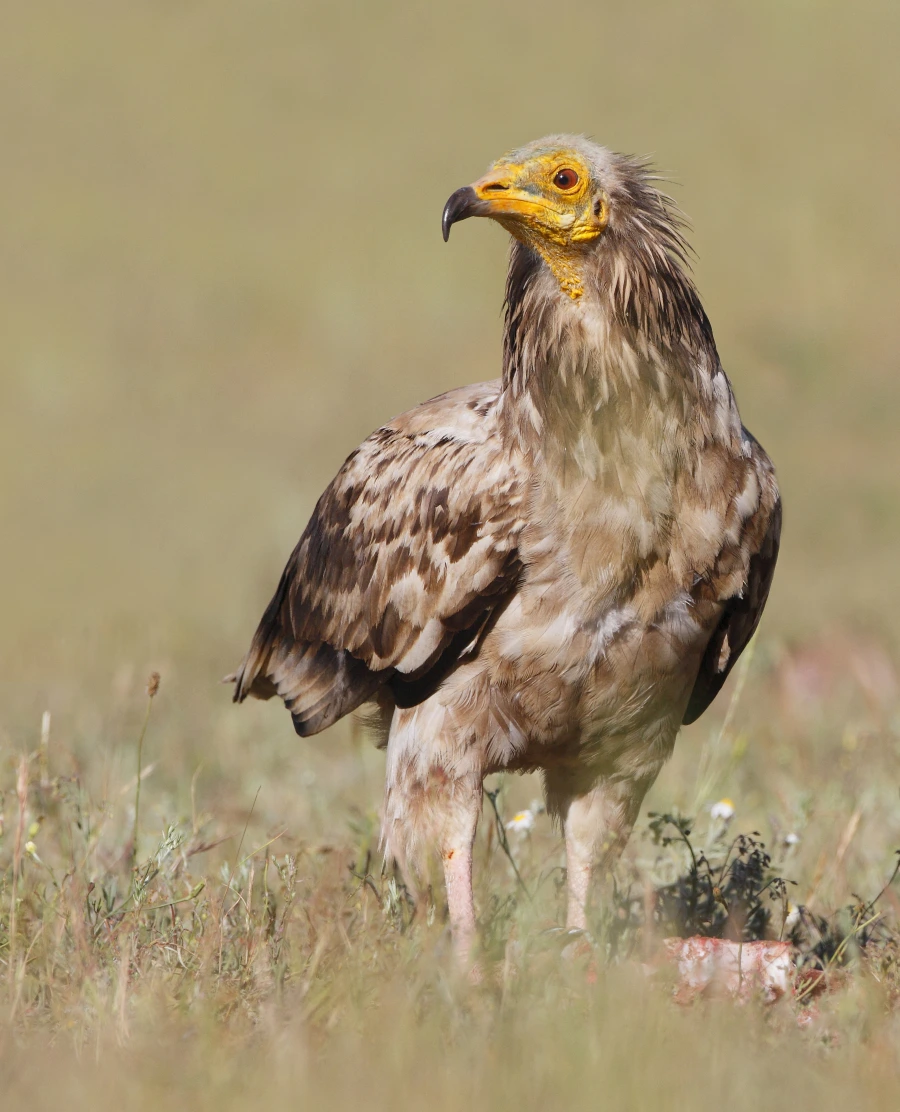
The Egyptian vulture is categorised as “endangered” on the IUCN Red List with a declining global population of between just 12,400 and 36,000.[10] It can be easily recognised as it’s the only vulture in Egypt with black and white plumage when seen from below, with white tail and black flight feathers. Egypt is also one of the most likely countries to see it, as although only a few Egyptian vultures breed in Egypt, the country’s Red Sea coast and Sinai peninsula are a migratory bottleneck across which the birds must travel as they pass from Africa to Asia and back in the spring and autumn.
A few Egyptian vultures are thought to breed in the Wadi El Gemal and Gebel Elba national parks, but this hasn’t been confirmed. The best places to see them, within easy excursion distance from Marsa Alam, are either in the vicinity of the Shalateen camel market, where they are usually found near recently deceased camels or close to any waste dumps, or in the hills around the small town of Sheikh el-Shazeli (الشيخ الشاذلى), home to the shrine of the seventh century sheikh Imām Nūr al-Dīn Abū al-Ḥasan ʻAlī al-Shādhilī, where livestock is slaughtered during the annual Shazeli Feast, coinciding with Eid el-Adha.[11]
The Eurasian Curlew
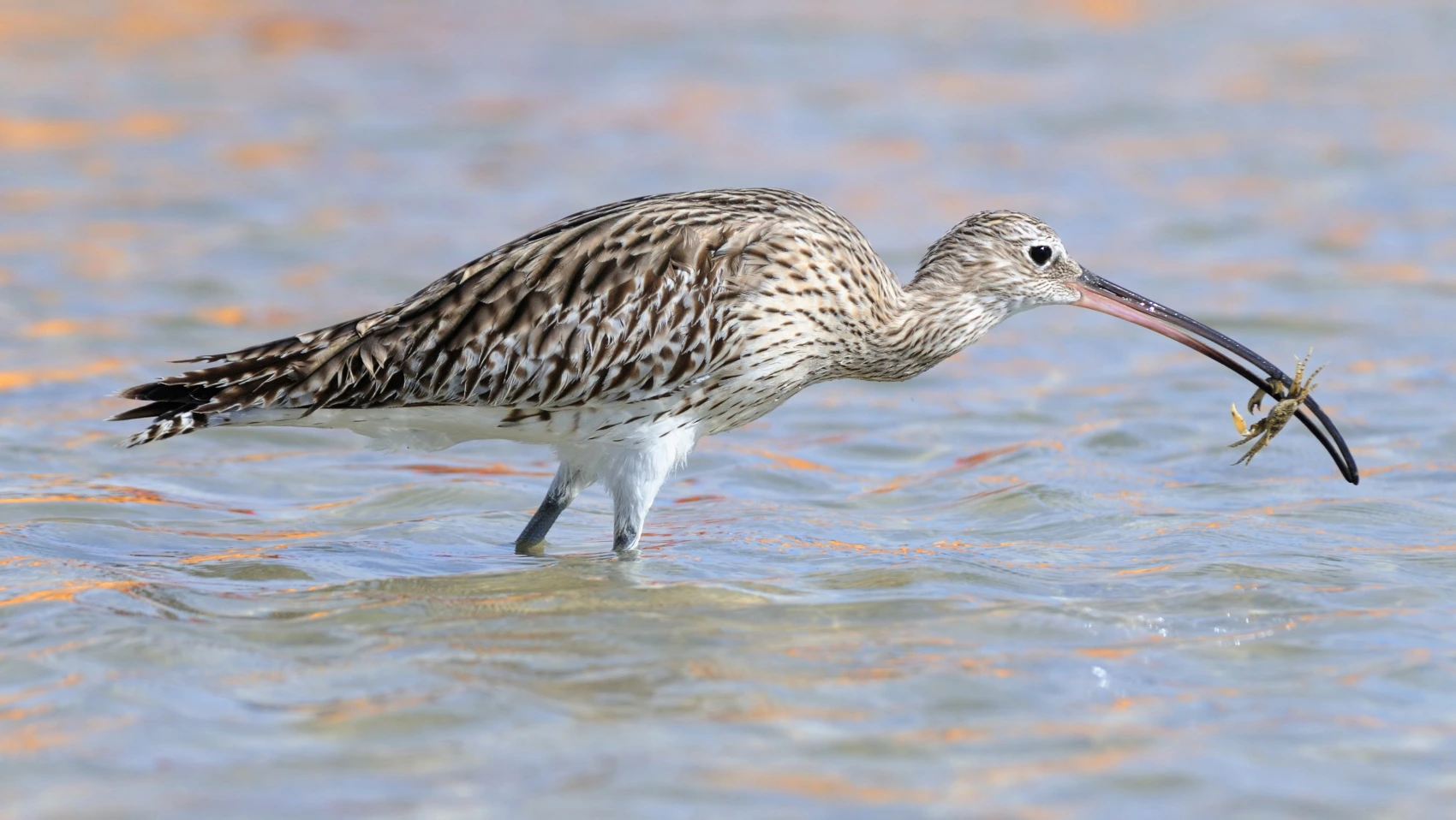
Photo credit: Sami Lakis/Shutterstock.com
ID 60350643 | © Victortyakht | Dreamstime.com
Scientific name: numenius arquata – Arabic name: karawaan al-maa- كروان الماء
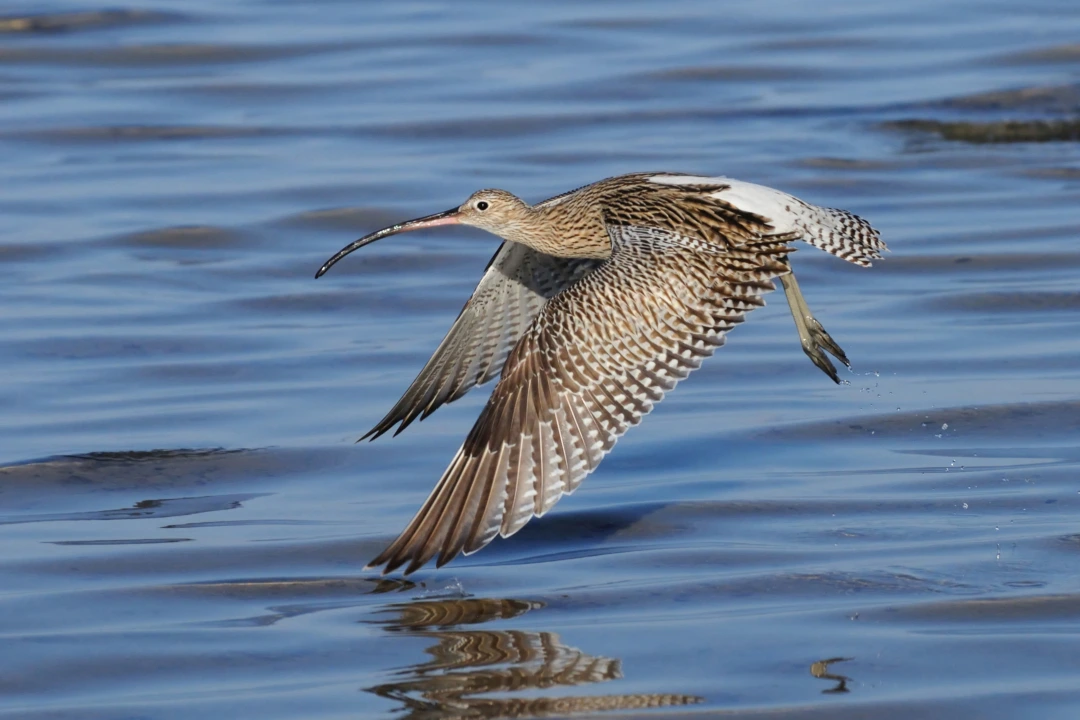
The Eurasian curlew is one of the largest wading birds at about 50 to 60 cm, 20 to 24 inches in length, a wingspan of 89–106 cm (35–42 in) and a body weight ranging from 540 to 1050 grams.[12] It can be easily recognised by its distinctive down curved bill, long legs and what Birdlife.org calls its “bubbling ‘cur lee’ call” – one possible origin of its name.
It is an autumn and winter visitor to Egypt and can be seen almost anywhere along Egypt’s Red Sea coast. Steven M Goodman et al note in their comprehensive 1989 study “The Birds of Egypt” that “flocks of up to 60 are regularly reported from along the Red Sea coast,” though it’s probably most commonly seen on the Sinai peninsular and particularly at the shoreline and beaches around Sharm El Sheikh where both the above photographs were taken.
It is also occasionally seen further inland in Egypt, including Wadi El Natrun (between Cairo and Alexandria), along the Nile Valley and at Lake Qarun (about 80 km south west of Cairo), which is also a popular wintering location for many other migratory birds. It has even been seen in as remote a location as the desert oasis of Siwa.[13] The bird is also a winter visitor in other parts of Africa and can be seen year round along coasts, heathlands and wetlands across Europe and Asia, from the west coast of Ireland to north eastern China.
The Eurasian curlew feeds on worms and shellfish, especially crustaceans like crabs (as seen in one of the photographs) and shrimps, which, according to the UK’s Wildfowl and Wetlands Trust (WWT), they “find in the ground through the sensitive touch of their long curved bill,” which acts “like a pair of tweezers or chopsticks to pincer its prey in the mud.”
In recent years the Eurasian curlew’s global population is estimated to have declined rapidly by around 30% (WWT), with much higher declines in some breeding areas such as Wales (80%) and Ireland (90%) (Curlewcountry.org) and the bird has bee classified as “Near Threatened” on the IUCN Red List since 2008.
The Great Egret

Kora27 CC BY-SA 4.0 via Wikimedia Commons
Vyacheslav Argenberg CC BY 4.0 via Wikimedia
Scientific name: Ardea alba – Arabic name: balashoon abyad kabeer بلشون أبيض كبير
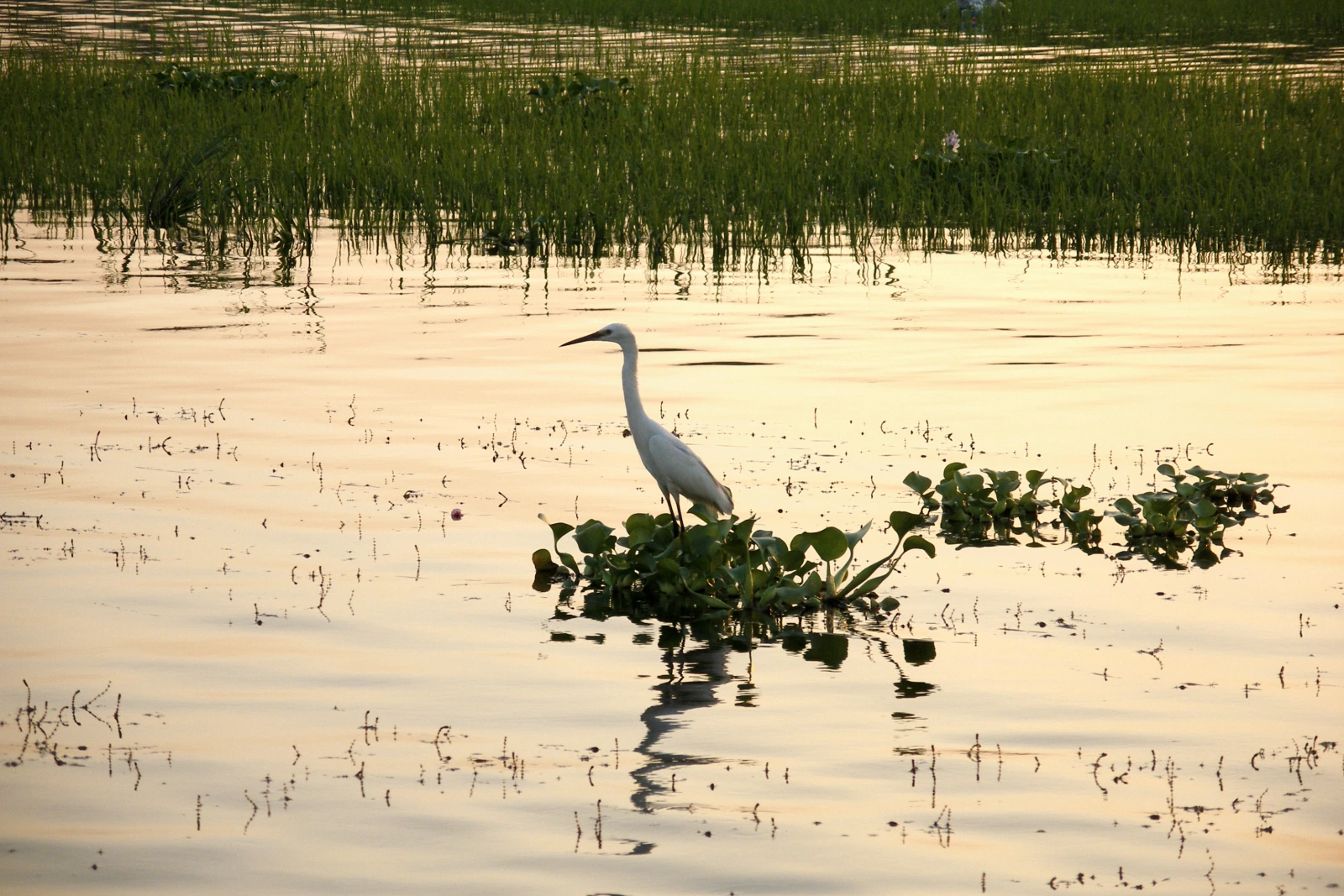
The great egret is a large slender egret with a distinctively long neck, often appearing s-shaped, particularly when relaxed or in flight as you can see in the following linked photo, taken by Chris Kehoe in September 2024, of a great egret flying near Hurghada. The typical great egret has a length which varies between about 80 cm and a metre, a wingspan of about 1.55 metres and a weight of around 800 to 925 grams, feeding mainly on fish, but also on molluscs, crustaceans and aquatic insects.[70] It has a wide global distribution and can be seen in at least some regions within almost every continent (except Antarctica).
Within Egypt, it is primarily a winter visitor during its migration between early September and late March, when it can be occasionally seen in the Nile Valley or at the Nile Delta’s coastal lakes, on the North Sinai coast, along the Suez canal or on Egypt’s Red Sea coast, often among other herons and egrets at coastal lagoons and mangrove swamps.[71] During the nineteenth and much of the twentieth century, hunters in Egypt killed large numbers of the bird as well as the little egret for sport, fashionable millinery products and consumption. Even as late as a study undertaken between January 1979 and December 1986, as many as 34 great egrets were seen for sale at Port Said market.[72]
The Greater Sand Plover
Scientific name: Pluvialis fulva – Arabic name: qatqaat arraml al kabeer قطقاط الرمل الكبير
The greater sand plover is frequently seen along Egypt’s Red Sea and Mediterranean coast (usually East of Alexandria), in most cases as a passing migrant bird, although it is thought that a few may breed in coastal locations. Occasionally they have been spotted inland, at the lakes and marshes at Wadi El Natrun just west of the Nile Delta, at Lake Qarun (about 80 km south west of Cairo) and rarely in the Nile Valley (at Beni Hassan in 1977 and Kom Ombo in 1985).[14]
They are most likely to be seen during the winter months, although they can be seen in any month from late July to May and occasionally as late as mid June. There’s also a good chance to see a large migratory flock, with those migrating southwards towards East Africa usually seen at any time from late July to January and those travelling northwards towards Turkey and central Asia usually at any time between late February and May. A flock as large as 50 has been seen at El Quseir, as large as 79 at Hurghada and as large as 220 at Suez.[15]
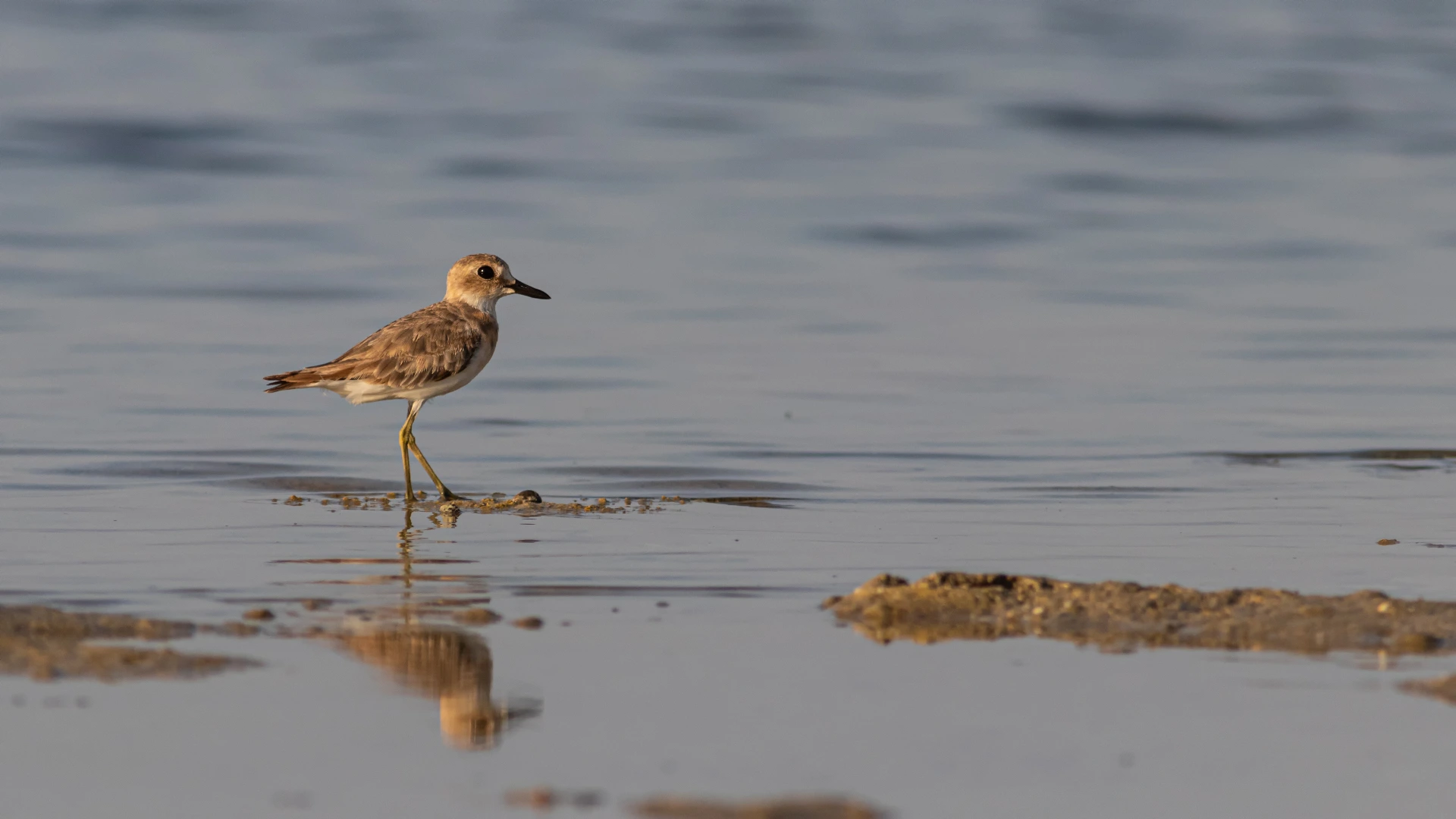
The bird, although small for a wader, is large for a plover with a typical length of 24 cm, wingspan of 56 cm and a weight varying between 75 and 112 grams.[16] It can be distinguished from the smaller sand plover by its longer legs and bill. It often hunts for its food at low tide close to or at the water’s edge (as seen in the photograph above), with its diet consisting mainly of insects, worms, snails, crabs and shrimps.
The Grey Heron
Scientific name: Ardea cinerea – Arabic name: balashoon ‘armad بلشون أرمد
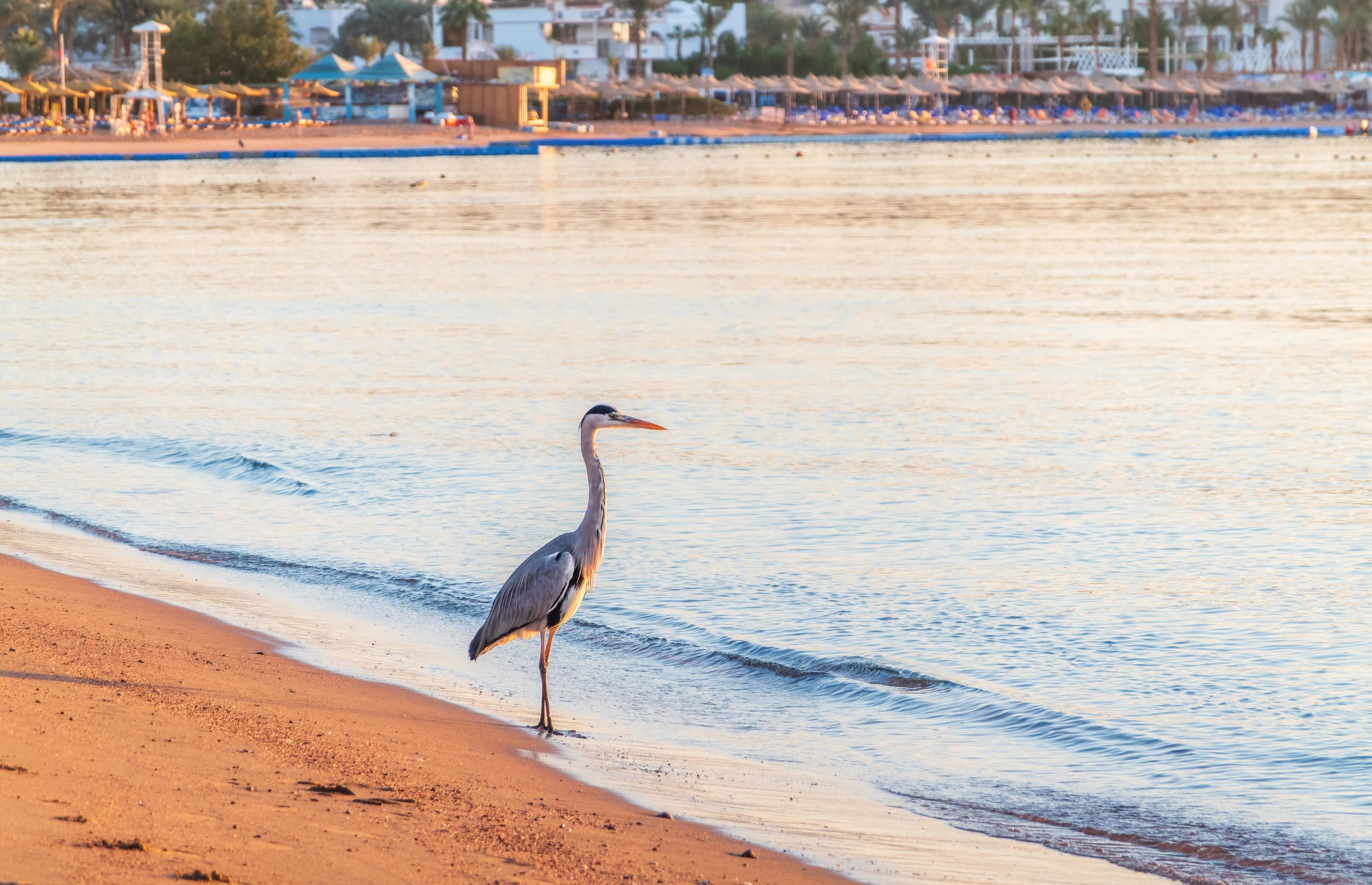
The grey heron is a large and easily recognisable heron with a mixed grey, black and white plumage. It has a length ranging from about 90 to 98 cm and a wingspan of between 175 and 195 cm, with an adult grey heron weighing from 1.4 kg to 2 kg, significantly heavier than the similar sized great egret.[73] They are opportunistic feeders and their prey can vary accordingly. While fish and crustaceans usually form the bulk of their diet, they can also prey on insects, worms, small birds, carrion, fish scraps from fishing boats and even small mammals such as amphibians and rodents.[74]
The bird is a common migrant visitor to Egypt between mid August and early May, but might rarely be seen in earlier summer months, and it is also possible that it might breed in a few localities. There is a record of a pair breeding within the grounds of Giza’s zoological gardens in the early twentieth century and there was a contested discovery of a grey heron nest at Marsa Suma (22°53’N 35°44’E) on Egypt’s Red Sea coast, just south of Shalateen, in 1984.[75]
Within Egypt it can be found commonly on inland wetlands along the Nile Valley and in the Delta, at the Western Desert Oases, and along both the Mediterranean and Red Sea coasts, particularly close to or within mangrove swamps, although you might see them on any hotel beach as evidenced in the above photograph taken at Sharm El Sheikh’s tourism, shopping, nightlife and partying hotspot of Naama Bay. However, if you are staying at Sharm El Sheikh, and want to see the grey heron and other sea and migratory birds, you can’t do better than either the Ras Mohammed National Park, 36 km to the south west, or the Nabq Protected Area, about 23 km to the north.[76]
Besides Sharm El Sheikh and the Sinai coast, you can also commonly see the grey heron at numerous locations along Egypt’s Red Sea coast including at the lagoons at El Gouna (north of Hurghada) and at Qulaan Mangrove Beach, a good hour’s drive (approximately 100 km) south of Marsa Alam or a few minutes drive north of Wady Lahmy Azur Resort. The bird has even been seen as far south as the small town of Abu Ramad, very close to the Sudan border and 132 km south east of Shalateen.[77]
The Hooded Crow
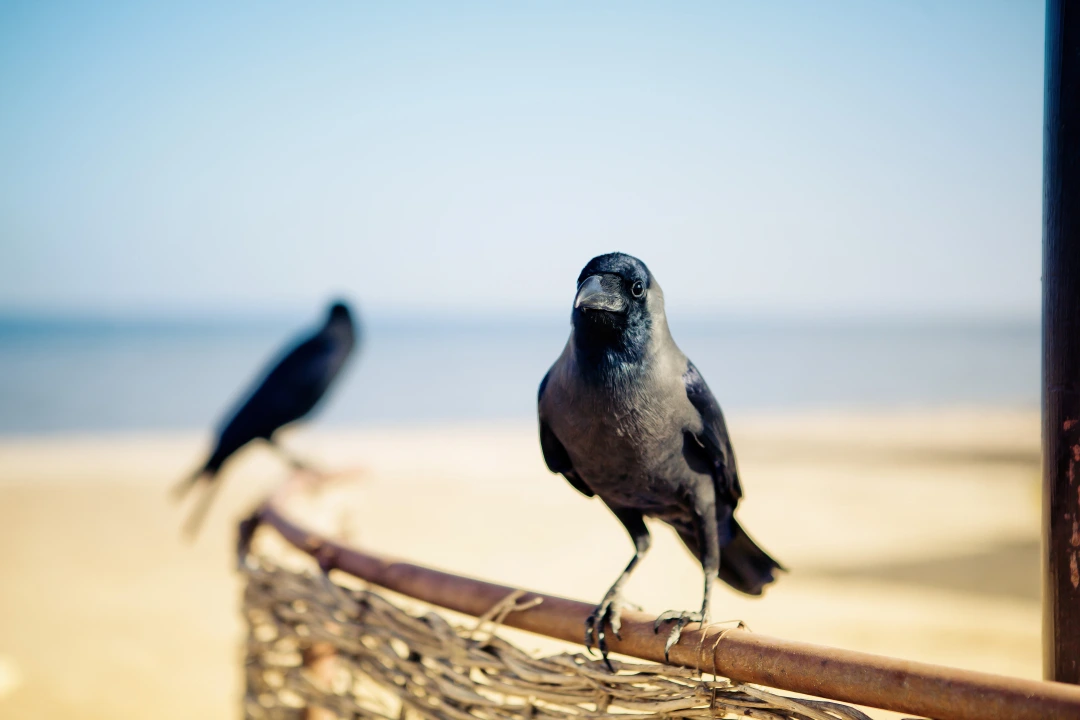
Scientific name: corvus cornix – Arabic name: ghuraab baladee غراب بلدي
The hooded crow is a close relative to the carrion crow which is resident across England, Wales, France and much of Western Europe. However it is the dominant crow species across Scandinavia, much of central Europe, Eastern Europe, Russia and the Middle East. However in Africa, it is only known to be resident in Egypt, and within Egypt its range is mostly restricted to the Delta, Nile Valley and Red Sea coast, being most commonly seen in urban areas and villages and on agricultural land.
It can be distinguished by its mostly grey body and its black head, throat, wings and tail. It is a separate species to the carrion crow but some interbreeding occasionally occurs where their habitats overlap. However, hooded crows are more likely to be sociable in their feeding habits. It has an opportunistic and omnivorous diet which can include insects, worms, beetles, dead livestock and animals, grain, eggs and young birds. The hooded crow’s typical length is 45 to 47 cm, with a wingspan of 93 to 104 cm and the usual weight range is between 370 and 650 grams.[17]
The Hoopoe
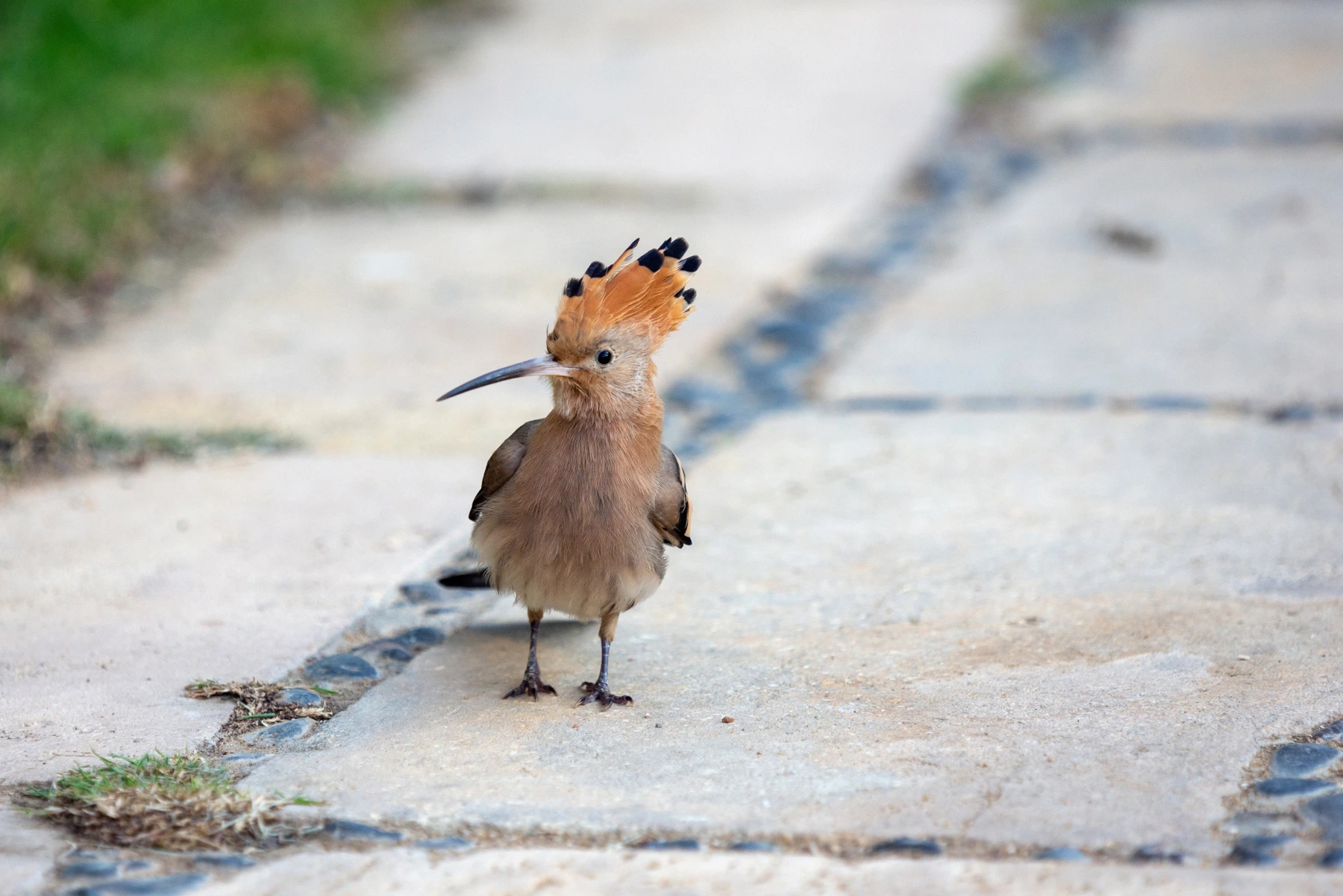
Scientific name: Upupa epops – Arabic name: Hudhud هدهد
The hoopoe is commonly seen along Egypt’s Nile Valley (north of Aswan) and Nile Delta regions, where it nests in holes in trees, walls and riverbanks. However, it can also often be seen in most other areas of the country, including along the Red Sea coast (especially from Hurghada northwards) during its autumn (mid August to early November) and spring (early March to May) migrations.
It is also known as a resident breeder along the north Sinai coast, the Suez Canal, at the lakes and marshes of Wadi El Natrun, Lake Qarun (80 km south west of Cairo) and at the Western Desert Oases of Bahariya, Dakhla, Farafra and Kharga and possibly at the Red Sea resort of Hurghada.[18] It has a range of preferred habitats including farmland, gardens, parks, orchards, heathland and woodland.
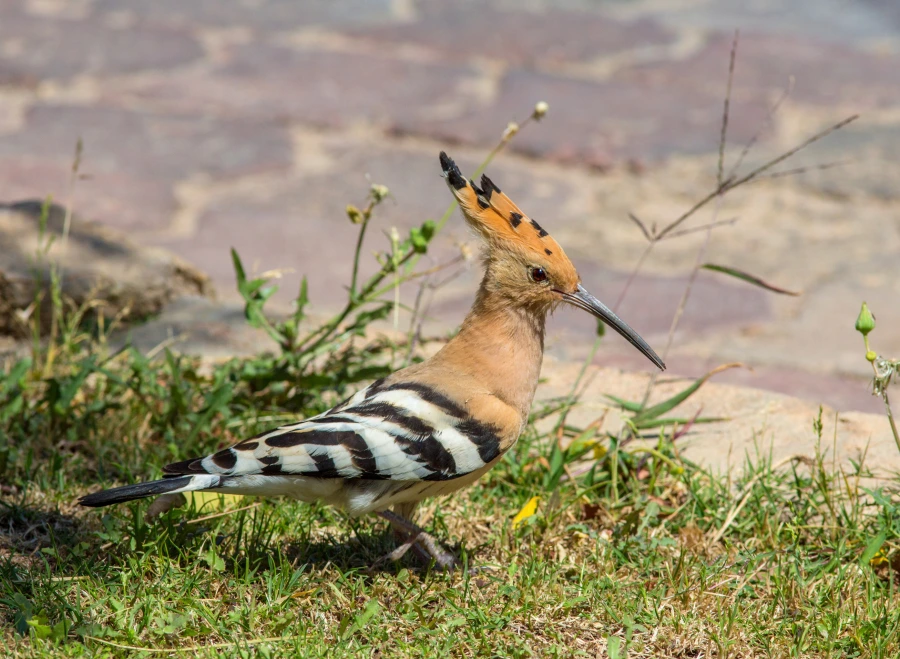
The hoopoe is one of the most recognisable and well known birds throughout Egypt and across large areas of Europe, particularly around the Eastern Mediterranean, as well as Africa, Asia and the Middle East, including along Saudi Arabia’s Red Sea Coast. It has a distinctive pinkish, orangish and brown plumage and an unmistakeable black tipped crest, with a total length of about 26 to 28 cm (including its downcurved black bill), a weight range of between 47 and 87 cm and a wingspan of around 42 to 46 cm.[19]
ID 63169203 | © Avkost | Dreamstime.com
Its global population is estimated at about 5 to 10 million, but is believed to be in decline due to habitat destruction and degradation (intensive farming and pesticides) and its trapping as a display pet or occasionally for subsistence food.[20] Large numbers of hoopoes used to fall prey in the 1980s to indiscriminate foreign and Egyptian bird hunters at Lake Qarun “who literally shoot every bird within range,” with smaller birds, including presumably hoopoes, usually subsequently discarded by middlemen who would buy up the dead birds. I’ve no information as to whether such indiscriminate hunting might still take place in some areas.[21]
The hoopoe’s own feeding preference is for large insects, including beetles, mole crickets, locusts and moths, as well as smaller insects such as ants and spiders, and occasionally worms, berries and even lizards and other small reptiles and amphibians.[22]
The House Sparrow
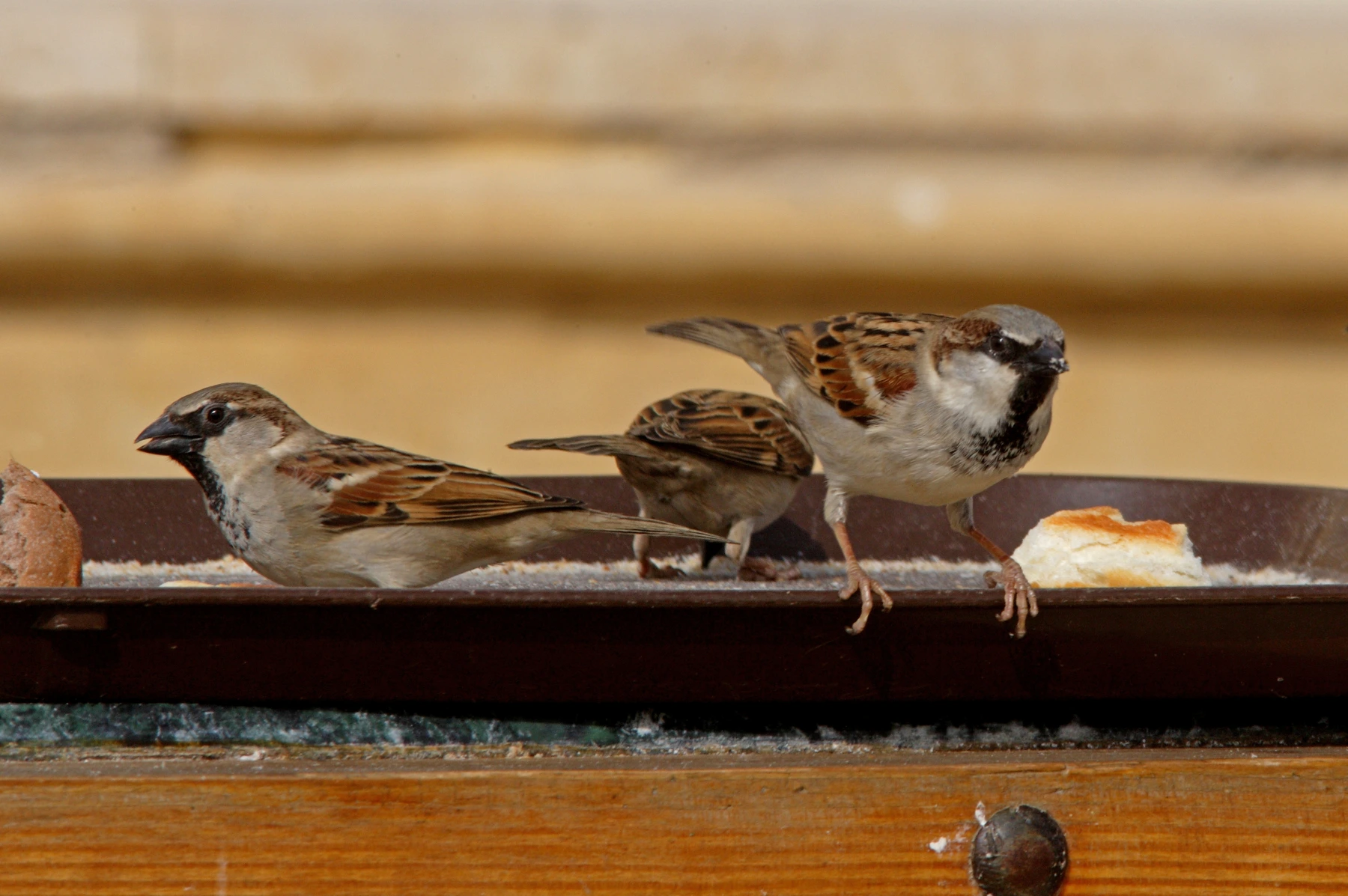
Scientific name: passer domesticus – Arabic name: usfuur duuree عسفور دوري
Until the late 1980s, there had not been a single sighting of a house sparrow south of Safaga on Egypt’s Red Sea coast, while in Sinai sightings were mostly confined to the Mediterranean coast, with sparrows being seen at Taba (on the Gulf of Aqaba) and at Na’ama Bay (at Sharm El Sheikh) only rarely.[23] However, as tourism and urbanisation expanded, sightings became more common and house sparrows are now frequently seen at Sharm El Sheikh (as evidenced in the photograph), while with the rapid development of hotels between El Quseir and Marsa Alam, they are also now often seen on the grounds of Marsa Alam’s hotels.
The house sparrow’s diet consists mainly of seed, insects and scraps.[24] While, generally, they prefer areas of habitation adjacent to farmland, the large number of hotel gardens, occasional (though infrequent) waste tips as well as leftovers on outside tables provide compensatory opportunities. Their population has also increased elsewhere in Egypt, particularly in the Nile Delta during the late twentieth century due to a shift towards the more intensified use of arable land and grain spillage near storage sites together with a reduction in the number of barn owls and other birds of prey.[25] This is in contrast to the United Kingdom where the population has decreased sharply.[26]
20 hot fried sparrows for one euro?
Some farmers regard the house sparrows as pests, while a few Egyptians continue to eat them as a cheap source of protein and, to cite Ahmed Maged of the Egyptian Daily News, “a coveted delicacy.” Maged interviewed a sparrow trader in Attaba market in central Cairo. As he handed over three pieces of sparrow to a customer in a paper cone, the seller explained that “Sparrows are a delicacy. Some people take two or three while others are content with having one bird plus two or three heads.” According to Maged, hot fried sparrows in 2015 cost 50 piastres for one bird or only one Egyptian pound for three, meaning you could have bought at least 20 for one euro.[27]
The Indian Silverbill
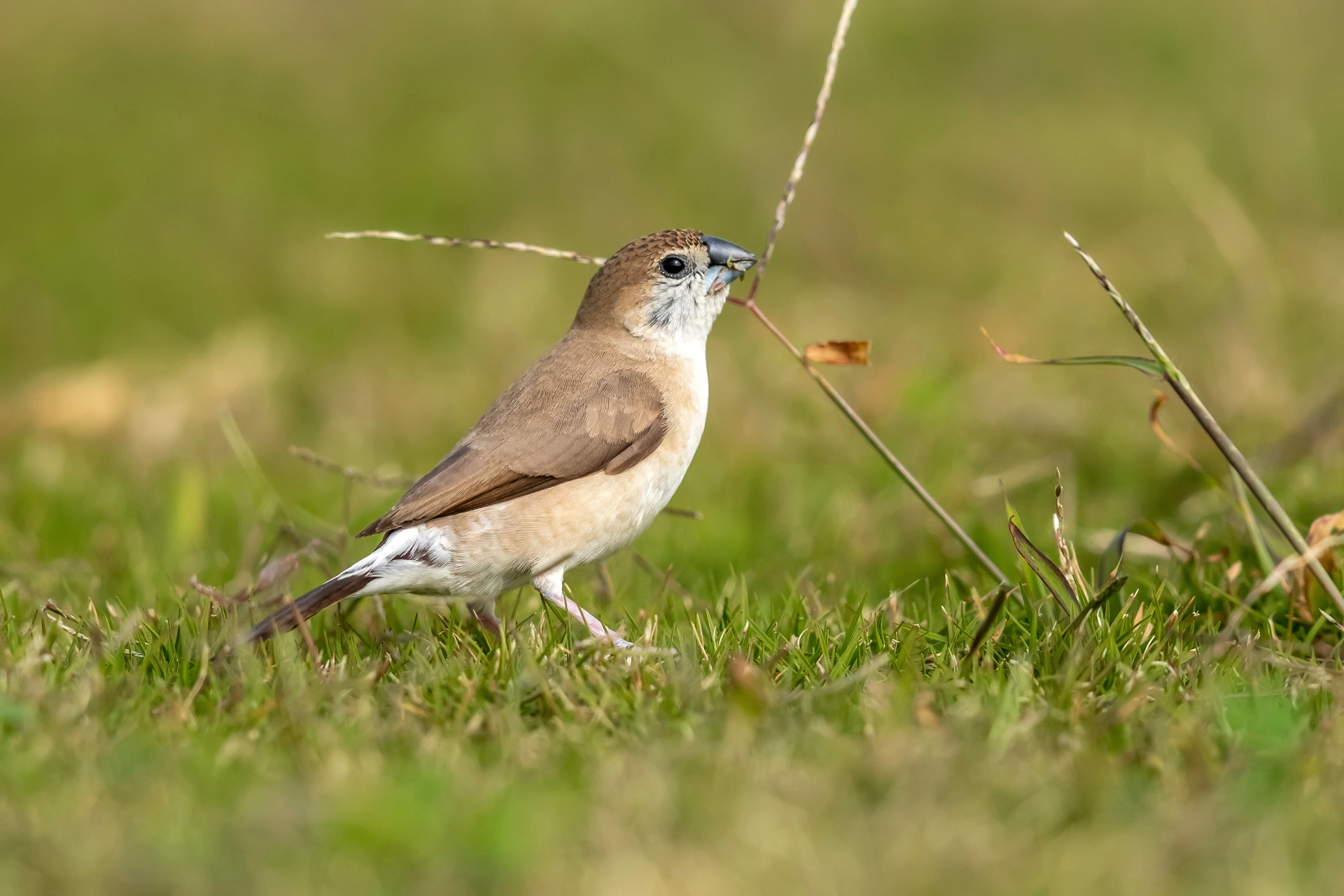
Scientific Name: Euodice cantans – Arabic name: fadi alminqar alhind فضي المنقار الهندي
The Indian silverbill is a small slim bird with beige-brown and cream plumage and a black pointed tail, and a heavy cone shaped dark silver beak. It has a length of about 11 to 11.5 cm, a wingspan of approximately 15 to 17 cm and a weight of about 10 to 14 grams.[28] It is granivorous foraging for various types of seeds, particularly grass seeds with its preferred habitats including grasslands, farmland, wadis, parks and gardens.
They have only appeared recently in Egypt, but are already resident in Cairo, the Nile Delta, Sinai and happily in the vicinity of Marsa Alam too, with the photograph above being taken at Lahami Bay Resort, 122 km ( 75 miles) south of the town.
The Laughing Dove
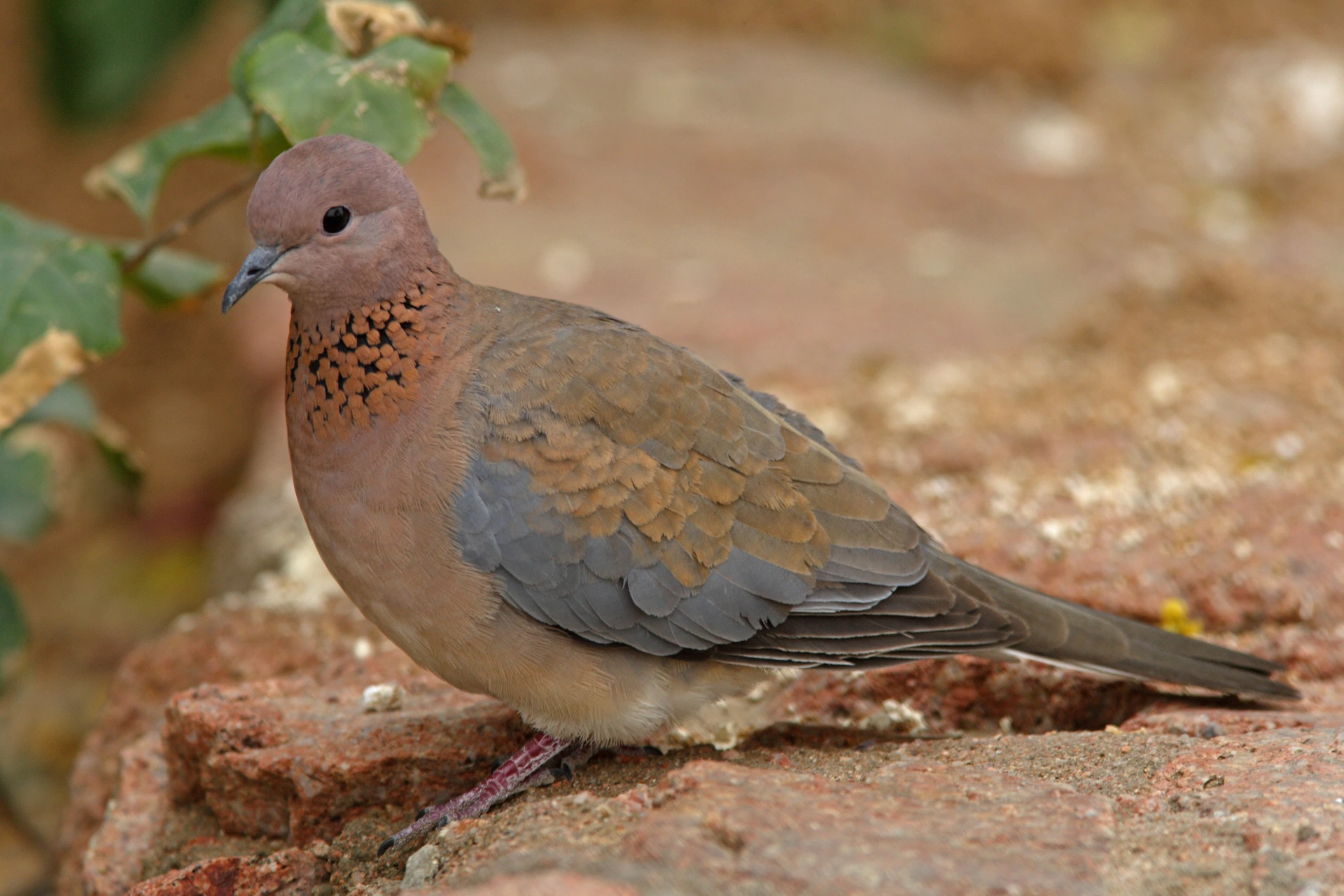
Scientific name: Streptopelia senegalensis – Arabic name: Yamaam baladee يامام بلدي
The laughing (or palm) dove is a commonly seen resident bird across many parts of Egypt, including the major cities of Cairo and Alexandria, the Nile Valley, the Nile Delta, the Western Desert oases, Sinai and along both the Mediterranean and Red Sea coasts.[29] It was first recorded in the then tiny fishing village of Marsa Alam as early as 1985, and was by then already also resident in the Red Sea towns of El Quseir, Hamrawein, Hurghada, Ain Sukhna and Ras Ghareb. The bird is also resident in plentiful numbers in the wadis with acacias in the Gebel Elba National Park. [30]
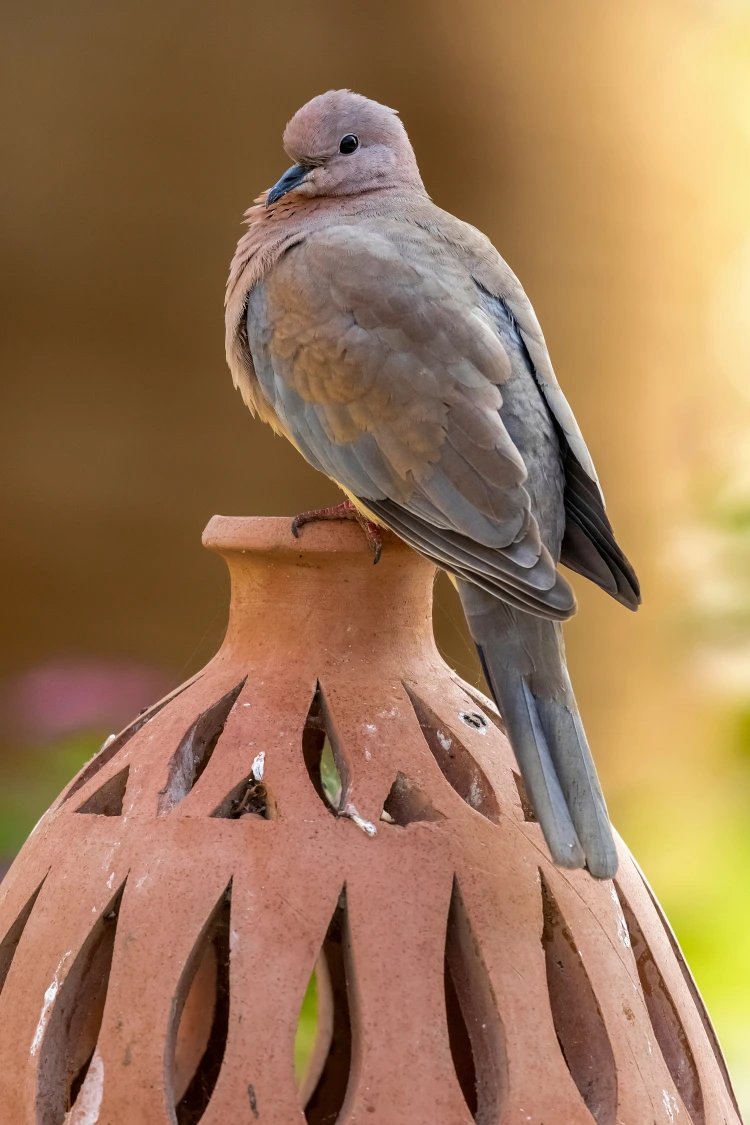
It is a small slim dove, with pinkish or reddish brown plumage on its upperparts and blueish grey bands on its relatively short wings, typically about 25-27 cm long, with a wingspan of about 40 to 45 cm and a weight of anywhere between 66.5 and 139 grams.[31] It can also be easily recognised by its distinctive song, described by Ornothologist and author Richard Porter succinctly as being “usually of five syllables, doo, doo, dooh, dooh, do, with the third and fourth notes longer and higher-pitched.”[32] You can also listen to its soft calling, almost gentle laughing (hence its name), sound on Youtube.
Outside Egypt, the bird is resident across much of Africa, the Middle East, Central Asia and the Indian subcontinent, with an estimated global population of between 2.4 and 8.2 million, so no surprise that its IUCN red list category is that of “least concern”.[33] The laughing dove usually feeds on seeds and berries, and also in some areas, much to the frustration of farmers, on food crops such as lentils and maize.[34]
Agami Photo Agency/Shutterstock.com
The Levant Sparrowhawk

Scientific name: Tachyspiza brevipes – Arabic name: baydaq بيدق
The Levant sparrowhawk is a relatively small bird of prey, being about 31 to 36 cm in length with a wingspan of about 69 to 75 cm and a weight ranging from 180 to 290 grams for the female and 140 to 270 grams for the male.[35] The bird’s diet consists primarily of small birds, lizards, small ground mammals such as rodents and large insects such as grasshoppers. Its global population is estimated to be stable at a low level, somewhere between just ten and twenty thousand mature individuals. However, that is still sufficient for it to avoid being categorised as vulnerable by the IUCN.[36]
It is a common sight along Egypt’s Red Sea coast and the Sinai during its biyearly migration between its temperate breeding grounds in the Balkans, Turkey, Ukraine, southern Russia and Caucasia and its wintering grounds in East Africa. They are also often seen over the Eastern Desert, but only occasional and infrequent sightings of individual Levant sparrowhawks are ever spotted further west in the Nile Valley.
In spring from mid March to mid May, flocks of them, often of considerable size, migrate northwards along the Eastern Desert and Red Sea Coast, usually crossing the Gulf of Suez and then passing Sharm El Sheikh and heading up the eastern coast of Sinai towards their summer habitats in Europe and Asia. On peak days over a thousand sparrowhawks might pass by on a single day.
On 11 May 1961, “thousands” were observed heading east across the Gulf of Suez near Ashrafi island (approximately 30 km north of El Gouna), on 20 April 1977, 2,558 were counted migrating northwards across the Egyptian-Israeli frontier at Eilat and on 22 April 1979, 1,440 were counted at Ras Mohammed (near Sharm El Sheikh). Smaller numbers have also been observed heading northwards up the Gulf of Suez towards the Suez Canal and North Sinai.[37]
The birds can also be seen on their reverse migratory journey southwards between mid September and November, although large numbers don’t seem to be as routinely seen. For instance, while over 16,000 were counted heading south over central Israel during the autumn of 1981, few were seen, over either Israel or along the eastern Sinai coast, during subsequent years of that decade.[38] It’s not clear whether this might be due to there taking a different southwards route.
The Osprey
![An osprey perched on a rock at the Nabq Protected Area near Sharm El Sheikh.[39]
Photo credit: Victor Tyakht/Shutterstock.com](https://marsaalam.com/wp-content/uploads/2024/12/shutterstock_275835686-Victor-Tyakht-7-May-2015-241114-2155-1920p.webp)
Photo credit: Victor Tyakht/Shutterstock.com
Scientific name: Pandion haliaetus – Arabic name: Iqaab nisaareyya عقاب نسارية (sometimes also as iqaab assamak عقاب السمك meaning “fish eagle.”)
The Osprey is a large fish-eating bird of prey, with a typical length of 52 to 60 cm, a wingspan ranging from 145 to 165 cm and surprisingly light weight for its size (around 1.2 to 2.0 kg). In Egypt the most likely place to see it is along the Red Sea coast, where it breeds on beaches, on rocky outcrops, in mangroves and on offshore islands, usually in small colonies, though it can also sometimes be seen elsewhere near water, including in the vicinity of Lake Qarun (50 km south west of Cairo), at El Malaha lagoon on Sinai’s Mediterranean coast and along the Nile Valley.[40]
In the late 1980s, the total Egyptian resident breeding osprey population was thought to be around 150 to 200 pairs, and was then considered to be stable. Nesting sites were then identified at the Siyal Islands in the Gebel Elba Protected Area, at Zabargad (St. John’s) Island, Wadi El Gemal Island (about 50 km south south east of Marsa Alam near Shams Alam Resort), at various offshore islands near Hurghada and at the mouth of the Gulf of Suez, along the coast of Sinai and on Tiran Island (then Egyptian but ceded to Saudi Arabia in 2017) at the mouth of the Gulf of Aqaba.[41]
It’s possible that its population might have then been underestimated or have subsequently increased, as the more recent USAID guide “Where to watch birds in the Wadi El Gemal National Park and neighboring areas?” comments that “the species continues to flourish along the Red Sea and can be commonly seen perched on billboards and other manmade structures along the coast,” and adding that “the nests are quite easily accessible, particularly on the islands,” but also appealing to readers not to approach active nests.[42]
![An osprey, possibly on Egypt's Red Sea coast.[43]
Photo credit: Paul Vinten/Shutterstock.com](https://marsaalam.com/wp-content/uploads/2024/12/shutterstock_75130093-Paul-Vinten-12-Apr-2011-241102-1948-900p.webp)
Photo credit: Paul Vinten/Shutterstock.com
The Pharaoh Eagle-Owl
![A pharaoh eagle-owl in the desert near Marsa Alam.[44]
Photo credit: MWFP84/Shutterstock.com](https://marsaalam.com/wp-content/uploads/2024/12/shutterstock_2319315089-MWFP84-June-18-2023-241029-1005-1750p.webp)
Scientific name: Bubo ascalaphus – Arabic name: buahat fireawnia بوهة فرعونية
The pharaoh eagle-owl is a large owl, about 45 to 50 cm in length, a wingspan of about 42 to 43 cm and a weight of about 1.9 to 2.3 kilograms. It can be distinguished by its bright yellowy orange eyes against a pale almost cat-like face, and when viewed in the right circumstances, its pointed ear tufts. It loves deserts and mountains so the Eastern Desert around Marsa Alam is an ideal habitat. It hunts at night and according to the Owl Pages, it “roosts by day between rocks, either on the ground or in a steep precipice, cliff crevice or in a cave entrance,” though also sometimes in trees if they are available.[45]
Although they are nocturnal, you can often spot them early or late in the day sitting close to their nest. One happy Finnish birdwatcher recalled in his blog for 19 January 2013 that “Around 60km north of Marsa Alam (presumably about 10 km south of the airport) was a place where we had read from a report to be a Pharaoh Eagle Owl site. Only 1km from the coastal road was very promising looking site and bingo! There was Pharaoh Eagle Owl sitting on a cliff.”[46]
However, if you are not lucky by day, don’t worry because after sunset, if you listen out, you might one night hear its loud distinctive hooting call, which you can also hear here, recorded by Arnoud van den Berg for the Sound Approach collection of bird sound recordings.[47] It is during the night that it hunts its prey, which consists of birds, small mammals and reptiles, as well as larger insects and even scorpions.

Photo credit: ID 130878410 | © Kingmaphotos | Dreamstime.com
Outside Egypt, it is resident across extensive rocky desert, semi desert and mountain habitats from Morocco and the Western Sahara in the West to Oman and the Emirates in the East. According to Bird Life International, although its total population is unknown, it is thought to be stable and “the species is reported to be not uncommon in most of its range,” so therefore its IUCN category status is that of “Least concern.”[48]
The Sooty Gull
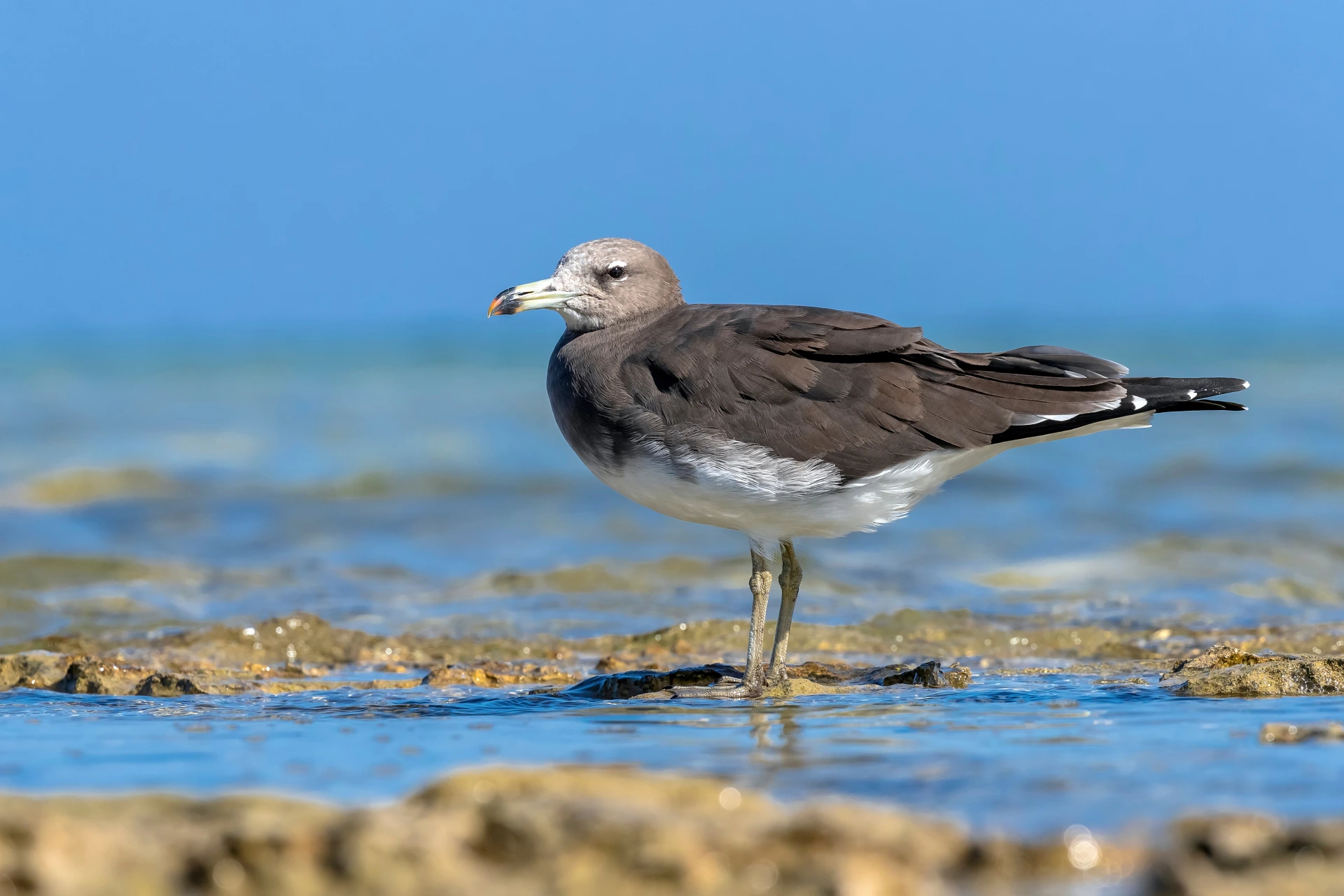
Scientific name: Larus Hemprichii – Arabic name: nuras askham نورس أسخم
The sooty gull, also sometimes called the Aden Gull or Hemprich’s gull, is a medium sized gull, of about 43 to 48 cm in length, with a wingspan ranging from 105 to 188 cm and a weight of about 400 to 510 grams.[50] It is a coastal bird, rarely venturing further than 10 km out to sea, with its habitat range extending from the Red Sea and East African coast in the West, through the Gulf of Aden and the Persian Gulf to the southern coast of Iran and Pakistan in the East.
The sooty gull is a predator and scavenger, feeding on small fish, prawns, molluscs, newly hatched turtles, the eggs and chicks of other birds, especially of other seabird colonies, as well as dead fish and fish discarded by fishermen. It is an intelligent and adaptable bird, often following fishing vessels for offal and in Egypt two sooty gulls were observed resorting to repeated prey dropping behaviour, from about six metres above the rocks, to break the shells of large clams they wanted to eat.[51]
You’ll notice in the photograph above that it has a large distinctive bill with a black band preceding an orangey red tip. The sooty gull differs from the white eyed gull, also resident along Egypt’s Red Sea coast, in that it has white only above its eye and not below, while its upperparts are browner and less grey.[52]
It nests between July and September, and records from the 1980s show that it was already known or believed to be breeding at at least seven island locations just off Egypt’s Red Sea coast, including (starting from the mouth of the Gulf of Suez and working southwards) –
- Gezira Ashrafi (27°46’N 33°41’E) – definite
- Gezira Umm El Heimat (27°42’N 33°37’E) – probable
- Gezira Tawila (27°35’N 33°46’E) – probable
- Gezira Umm Agawish el Kabir (27°09’N 33°52’E) – probable
- Gezira Wadi Gemal (24°40’N 35°10’E – about 60 km SSE of Marsa Alam) – definite
- Gezira Mahabis (24°19’N 35°23’E – off Hamata) – probable
- Siyal islands (approx. 22°47’N 36°16’E – Gebel Elba National Park) – definite
The largest sighting during that period was in 1984, when 233 birds including chicks were seen on Gezira Ashrafi, although they were (and still are) common on the islands and southern Egyptian Red Sea coastline, with Steven M. Goodman et al. noting that “small flocks of up to 50 birds, often mixed with white-eyed gulls, are regularly observed throughout the year on Red Sea islands and along the coast from Hurghada southwards.”[53] Much more recently, Richard Hoath reports their distribution similarly “In Egypt throughout Red Sea, breeding from Hurghada south.”[54]
The coastline to the south of Marsa Alam seems to be a near perfect location to observe it. The USAID Egypt booklet, “Where to watch birds in Wadi El-Gemal National Park and Neighboring Areas?” comments that although it is found “in smaller numbers than the white-eyed gull…. this species is especially common in WGNP (Wadi El-Gemal National Park) and can be easily seen at the beach at the Shams Alam hotel and at Qulan and Hamata.”[55] You can also find a photograph of the gull on Shutterstock (but not the same as the one above) taken at Wadi Lahami (presumably close to Lahami Bay Beach Resort) near Hamata.
In contrast, the sooty gull is rarely, if ever, seen on Egypt’s Mediterranean coast and although there is a sighting dating back to February 1925, it is thought that it was the very similar looking white-eyed gull which was probably seen.[56]
The Steppe Eagle

Photo credit: ID 92674274 | © Rakesh Sharma | Dreamstime.com
Scientific name: Aquila nipalensis – Arabic name: eiqab assuhub عقاب السهوب
The steppe eagle is a very large eagle with a length of about 62 to 79 cm, an enormous wingspan ranging from 165 to 200 cm and a weight for males of between two and three kilograms, and for the significantly larger females of between 2.3 and 3.9 kilograms.[57] It feeds mainly on small birds, small mammals, reptiles, amphibians and carrion. The steppe eagle can be often seen in the Eastern Desert and Sinai during its spring migration from late January to mid May and its autumn migration from early September to late November, but is rarely seen in summer or mid-winter.[58]
You might guess from its name that it prefers open landscapes whether that’s the grasslands of European Russia and Central Asia, where it breeds in summer, or the savannas of East Africa, where it spends the winter, or the arid rocky landscapes of Sinai and the Eastern Desert, where it rests and feeds during its long migration. During the spring large numbers travel northwards over the mountains of the Eastern Desert, seemingly reluctant to head eastwards across the open sea and instead preferring to travel as far north as Suez, presumably so that they can take advantage of the thermal uplifts, before heading north eastwards towards their summer breeding grounds.
Consequently, the area around Suez is a migratory bottleneck, with records of as many as 8,240 steppe eagles spotted in a single day, according to a “systematic count of raptors at Suez…. on 25 October (1981).”[59] It’s possibly due to these frequent sightings historically and its impressive size that the bird is often depicted in ancient Egyptian temples and, it is claimed, was later adopted by sultan Salah Al-din as his personal standard. From 1952, the Egyptian red, white and black flag had Salah Al-din’s eagle at the centre, and many believe that represents the steppe eagle.[60]
Sadly, however, the steppe eagle is now thought to be in danger of extinction, with its population, according to the IUCN, having undergone “very rapid recent declines across much of the range,” adding that “it is therefore classified as Endangered.” When population studies from different areas were combined, the IUCN estimated that the steppe eagle’s population had declined dramatically by 58.6% between 1997-2011 (mid year 2004) and 2013-15 (mid year 2014), equivalent to falling by more than half in just 10 years. It listed several likely causes including
- Habitat destruction especially the conversion of steppe into agricultural land
- The shooting, trapping and poisoning of the birds
- Indirect (unintentional) poisoning through the use of pesticides
- Increasing collisions with power lines and wind turbines
- Increasing nest destruction due to fires and disturbance.[61]
The Striated Heron
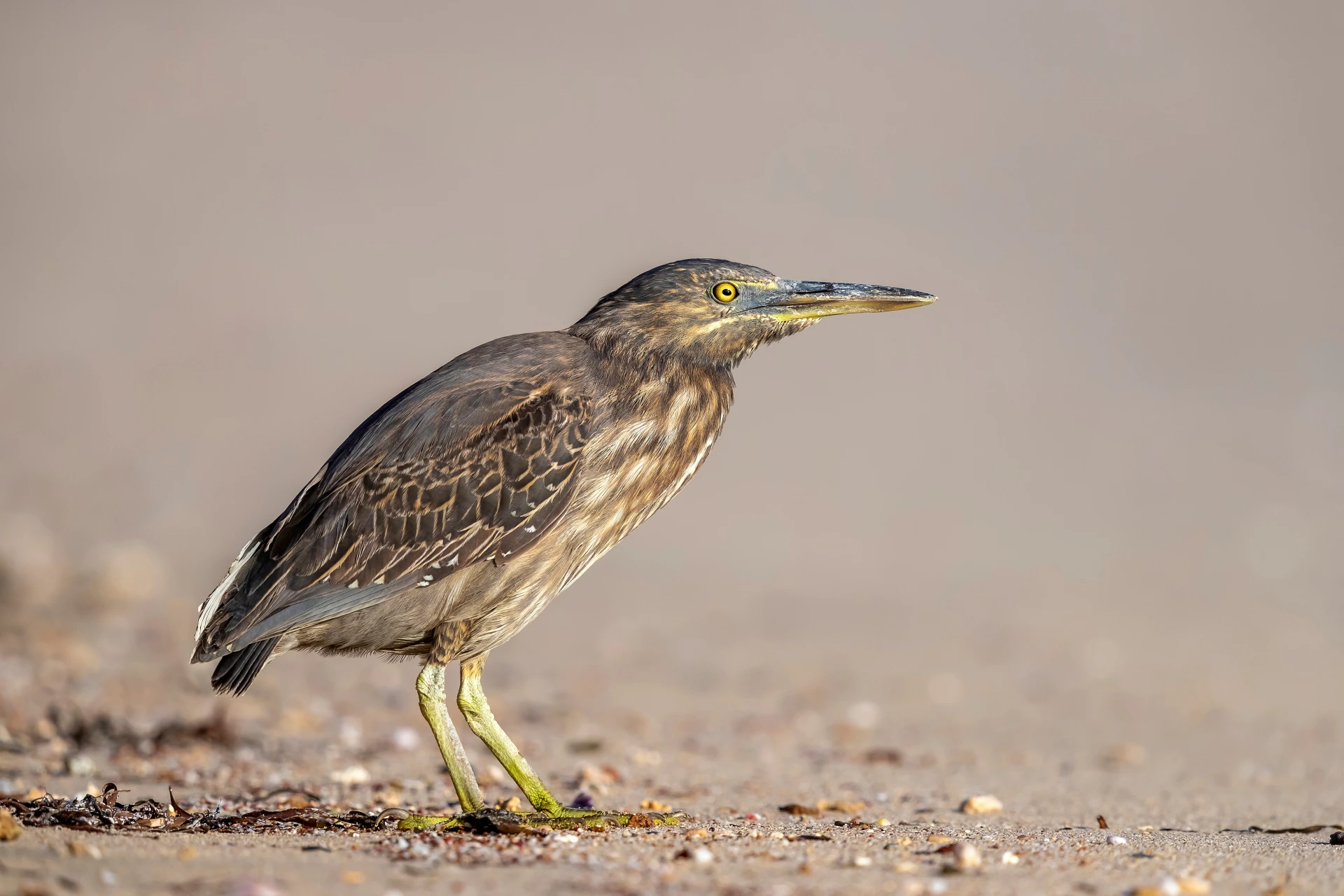
Agami Photo Agency/Shutterstock.com
Scientific name: Butorides striata – Arabic name: balashoon akhdar azzuhr بلشون أخضر الظهر
The striated heron, also sometimes called the mangrove or little heron, is a small squat heron with relatively short legs and a typically hunched posture. It has a length of only about 43 to 45 cm, a wingspan of around 60 cm and a weight of between 200 and 250 grams.[62] The adult bird can vary in the colour of its plumage, but usually has a bluey grey back and wings, although juveniles have dark brown plumage as in the above photograph taken on the beach of the popular Shams Alam Resort, just 50 km south of Marsa Alam.
As its “mangrove heron” nickname might suggest, the bird can often be seen in mangrove areas along the Red Sea coast, although it’s also frequently found on offshore islands, as well as being occasionally spotted inland along the Nile valley, even in Cairo, but usually where there is thick vegetation.[63] Besides Cairo, there are also records of it being seen along the Nile in Upper Egypt, including sightings at Qena, Luxor, Esna, between Esna and Edfu, south of Kom Ombo and at Aswan.[64]
Along the Sinai coast and offshore, there are records of the bird breeding at
- Shorat el Manqata: A lagoon with mangroves on the northern edge of the Nabq Protected Area.
- Gezira Tiran: Island at the mouth of the Gulf of Aqaba. Previously Egyptian ceded to Saudi Arabia in 2017.
- Ras Muhammad: At the southern tip of Sinai. A Protected Area with a small mangrove forest.[65]
Along the Red Sea coast south of Hurghada, there are records of it breeding at the following islands –
- Gezira Safaga (26°45’N 33°59’E)
- Gezira Wadi El Gemal (24°66’N 35°16’E – about 60 km SSE of Marsa Alam)
- Gezira Showarit. (24°22’N 35°23’E) At the centre of the island where there is a low lying mangrove lagoon.
- Gezira Umm Ladid (24°19’N 35°24’E)[66]
According to Steven M. Goodman et al., the absence of breeding reports from the islands much further north at the mouth of the Gulf of Suez may have been due to petroleum pollution in the area.[67]
Outside of the breeding season, the birds usually leave the nesting area and might be seen at many possible locations along the Red Sea coast, and especially along the coast both to the north and south of Marsa Alam. To the north, just 22 km south of El Quseir, it was reported in 2017 at the small lakes just to the north of Utopia Beach Club, as well as in the lagoon area between the outer reefs and the beach.[68]
The Red Sea coastline to the south of Marsa Alam is probably one of the best locations anywhere in Egypt to see the bird, especially where the coast lies within the Wadi El Gemal National Park and particularly along stretches where there are mangrove thickets. The photograph above was taken at the beach of Shams Alam Resort (50 km south of Marsa Alam) and you can see another photograph here of a striated heron seen another 50 km further south just off the coastal road at Qulaan Mangrove Beach (many great reviews on Tripadvisor) on 22 February 2024.
The Western Reef Heron
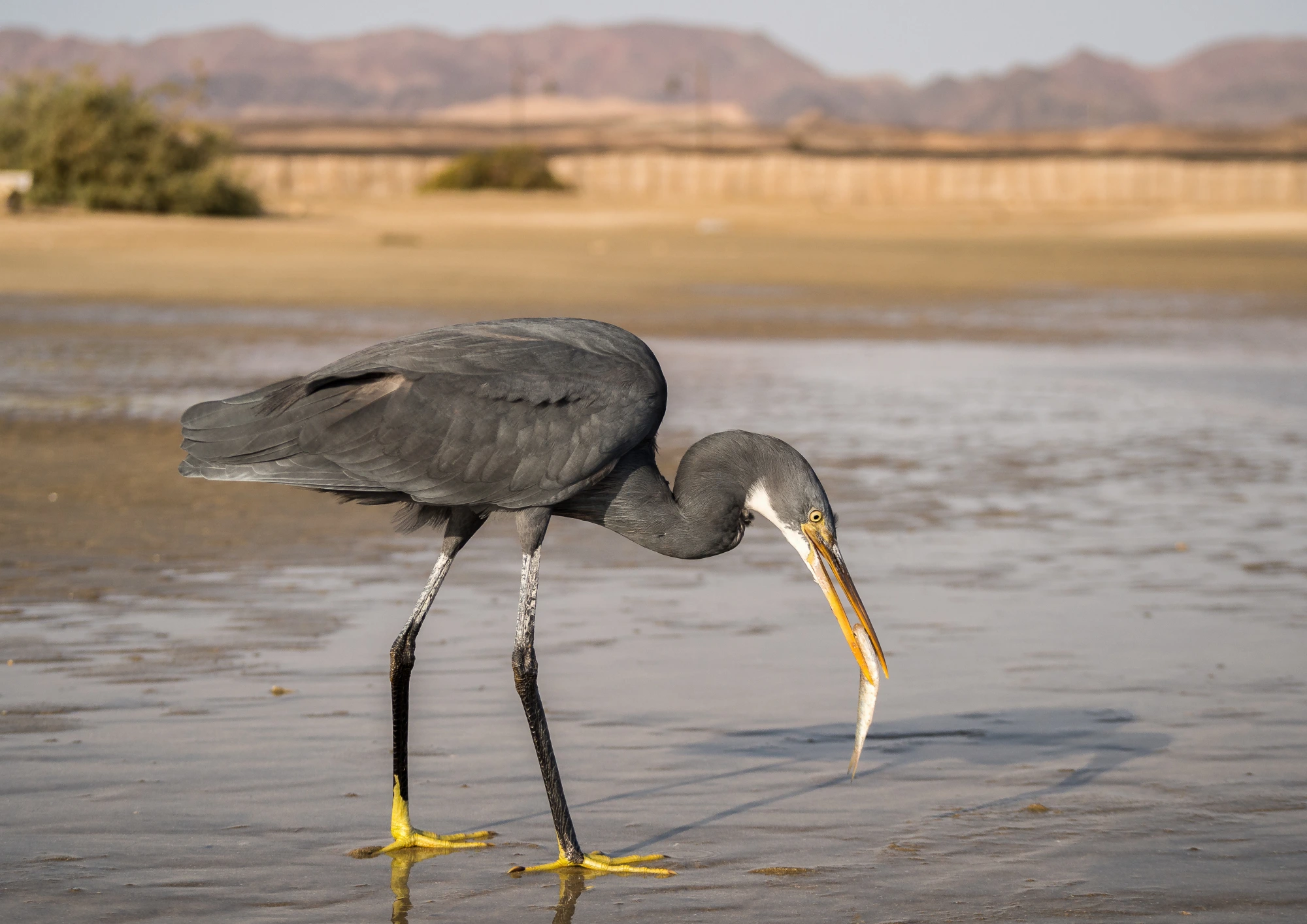
Serghei Vlasenco/Shutterstock.com
Scientific name: Egretta gularis – Arabic name: balashoon assakhr بلشون الصخر
The western reef heron, has two colour variations, a slate grey morph (as depicted above) with a white throat and a more common all-white morph. It is a medium sized heron with a length of approximately 55 to 65 cm, a wingspan ranging from 86 to 104 cm and a relatively modest weight of anything between as little as 280 and a maximum of around 710 grams.[78] The heron’s diet is primarily aquatic, including fish, crustaceans, amphibians and molluscs but also occasionally terrestrial, including insects, spiders, worms and small birds.[79]
It is a resident breeder at many locations along Egypt’s Red Sea coast from southern Sinai to the Halaib Triangle close to the Sudanese border, favouring mangrove swamps, rocky shorelines and islands.[80] In the late 1980s, according to Steven M. Goodman et al., Egypt’s total breeding population was then estimated at between 120 and 200 breeding pairs, with breeding colonies confirmed at
- Shorat El Manqata mangrove swamp and lagoon on the northern edge of the Nabq Protected Area (NPA), approximately 30 km north of Sharm El Sheikh. The western reef heron has also been spotted within the NPA more recently, with this photograph on Flickr of two white western reef herons taken there in August 2008, while ChrisA on birdforum.net reported in the spring of 2009 that the NPA and Ras Mohammed National Park were “worth a visit for” the western reef heron, as well as other birds, and also the location details of this photograph of a western reef on Alamy, taken in June 2015, are given as “Nabq beach.”
- Tiran Island at the mouth of the Gulf of Aqaba, which was under Egyptian sovereignty but which was ceded to Saudi Arabia in 2017.
- Ras Muhammed National Park, approximately 36 km south east of Sharm El Sheikh.
- Various islands at the mouth of the Gulf of Suez, lying between El Gouna on the western shore of the Red Sea and the Ras Mohammed National Park at the southernmost tip of the Sinai peninsular.
- The mangrove forest about 23 km south of Safaga and about 5 km north of Coral Sun Beach Resort.
- A mangrove swamp and lagoons which can be clearly seen on Google Earth about 42 km south of Safaga and approximately 40 km north of El Quseir.
- Sharm El Bahari (now called Mangrove Bay) 30 km south of El Quseir and on the south side of Mangrove Bay Resort.
- Gezira Wadi El Gemal (island) in the Wadi El Gemal National Park (24°66’N 35°16’E – about 60 km SSE of Marsa Alam).
- Mangroves 13 km north of Hamata
- Mangrove lagoon on the north western side of the Ras Banas peninsular.
- Mangroves at the south eastern tip of the Ras Banas peninsular.
- Mangroves just to the north of Bir al Hasa, about 15 km south of Shalateen.
- Marsa Sha’b opposite the Siyal Islands, about 60 km south of Shalateen.[81]
In the Marsa Alam area, the locations mentioned above at Mangrove Bay and Gezira Wadi El Gemal (island) as well as the Hamata area, including Qulaan Mangrove Beach and the offshore Hamata Islands, are well worth a visit for a very good chance of spotting a western reef heron and an impressive range of birdlife. To the south of Marsa Alam, birdwatchers along the Wadi El Gemal National Park and Hamata coastlines posted 10 photographs of both grey and white western reef herons on Inaturalist.lu between July 2023 and the summer of 2024. Generally, along the Red Sea coastline, the white morph outnumbers the grey by about four to one.[82]
The White-eyed Gull
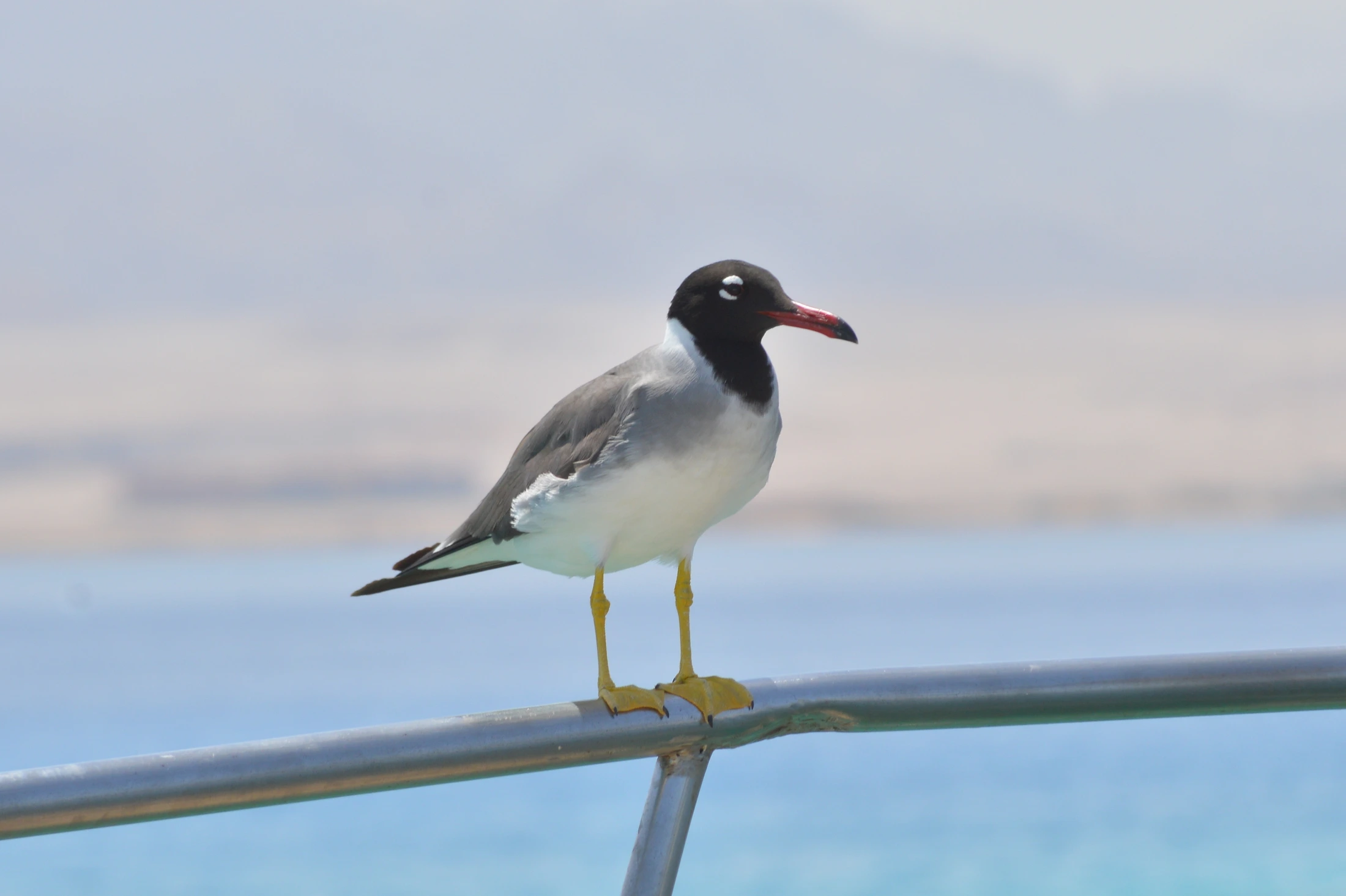
Scientific name: Ichthyaetus leucophthalmus – Arabic name: nuras ‘abyad aleayn نورس أبيض العين
The white-eyed gull has several distinctive features to help tell it apart from other gulls, including an obvious white patch above and below its eyes, with a truly black hood and bib (as distinct from the chocolate brown head of the black-headed gull), a dark red bill with a black tip and yellow feet.[83] It’s a small to medium sized gull, typically about 40 to 43 cm long from the tip of its bill to the end of its tail, with a wingspan of about 107 to 115 cm and a weight of between 275 and 450 grams.[84]
The white-eyed gull’s diet is primarily aquatic, mostly fish, crustaceans and molluscs, but it is also adaptive and opportunistic, following fishing vessels for unwanted fish parts and, when near hotels or urban areas, scavenging on almost any type of waste food dumped on landfills or otherwise discarded. It also occasionally feeds on insects, other birds’ eggs and even hatchlings.[85]
Its primary habitat is the Red Sea and Gulf of Aden, where it breeds along rocky cliffs and on inshore islands, although the bird is known as an occasional vagrant as far as Egypt’s Mediterranean coast, Somalia, Oman and even, during 2022, the United Arab Emirates.[86] According to Richard Hoath’s 2021 guide to the “Birds of Egypt and the Middle East,” they can be seen almost anywhere along Egypt’s Red Sea coast and breed “from Hurghada south and in the Gulf of Aqaba.”[87]
Steven M. Goodman et al.’s earlier 1989 study of “The Birds of Egypt” also noted a large scale breeding population on islands off Hurghada, as well as at the mouth of the Gulf of Suez, estimated at about 1,500-2,000 pairs of birds in total. The white-eyed gull typically breeds between July and September, and Steven M Goodman et al. comment that afterwards they “disperse widely,” and also that “throughout the year flocks of up to several hundred are observed along the coast from Hurghada to the Sudanese border.”
They also add that they can also be commonly seen along Egypt’s Red Sea coast a long way north of Hurghada, explaining that “a considerable number are found throughout the year in the Gulf of Suez,” and that it is also “regularly noted in the Suez Canal,” and that in both areas the greatest numbers were likely to be seen in the spring and summer.[88] It’s not clear whether it is still seen so often in the Gulf of Suez and Suez Canal, although there is a report on ebird.org of 8 seen as far north as Port Said at the northern end of the canal on 21 November 2008.
I’ve also seen reports of white-eyed gulls on the beach at Sharm El Sheikh, with birdwatcher Steve Baines reporting that during his visit in May 2009, “white-eyed gulls were present around the resort area in large numbers.”[89] There was also a sighting of at least one white-eyed gull in Sharm El Sheikh as recently as January 2024 on ebird.org and a photograph by Neil Bowman on Shutterstock of one perched on a rock at Sharm El Sheikh that seems to have been taken in February 2024, so it is still probably commonly seen there.
If you are visiting Marsa Alam or the nearby Wadi El Gemal National Park (WGNP), you’ll be pleased to know that the white-eyed gull can be found year round and is particularly easy to spot during the summer. According to the USAID Egypt booklet guide to watching birds in the WGNP and neighbouring areas, the breeding season in the islands off the coastline runs from June to September.[90] “This,” the guide explains, “is the best time to observe this most beautiful and graceful of all gulls,” adding that “one of the best places to get a close look at these creatures in summer is in hotel swimming pools, where these birds have learned to come and drink in droves!”[91]
Footnotes
- USAID Egypt, Where to watch birds in Wadi el-Gemal National Park and Neighboring Areas? Livelihood and Income from the Environment (LIFE), Sustainable Economic Development in the Red Sea Project, p.18.
- Steven M. Goodman et al., The Birds of Egypt, Oxford University Press, January 1989, p 487.
- Ibid., p 385.
- Richard Porter and David Cottridge, A Photographic Guide to Birds of Egypt and the Middle East, The American University Press in Cairo, 2001, p. 100.
- Steven M. Goodman et al., The Birds of Egypt, Oxford University Press, January 1989, p. 68, p. 95 and p. 134.
- Ibid. p. 134.
- Stephen Moss, “Cattle egrets: how changing climate brought a bird of the tropics to UK,” The Guardian, 18 January 2024.
- Bird Life International cattle egret factsheet
- Richard Porter and David Cottridge, Op cit., p72.
- Bird Life International Egyptian vulture factsheet
- USAID Egypt, Where to watch birds in Wadi el-Gemal National Park and Neighboring Areas? Livelihood and Income from the Environment (LIFE), Sustainable Economic Development in the Red Sea Project, p. 9 and p. 25.
- Dunning, John B. Jr., ed. (1992). CRC Handbook of Avian Body Masses. CRC Press, 2007. Weight range given for the male and female Eurasian curlew on page 107. The male birds range from 540 to 900 grams with a mean of 742 and the female birds range from 720 to 1050 with a mean of 869. The wingspan cited on Birdlife.org The typical length of 50 to 60 cm is cited by the Royal Society for the Protection of Birds and the Wildfowl and Wetlands Trust.
- Steven M. Goodman et al., The Birds of Egypt, Oxford University Press, January 1989 , pp. 266-267.
- Ibid., p 248.
- Ibid.
- Richard Hoath, A Naturalist’s Guide to the Birds of Egypt and the Middle East, John Beaufoy Publishing, Oxford, 2021, p. 60 and Colin Jackson, “Clues towards the migration route for Greater and Lesser Sand Plovers spending the non-breeding season in Kenya,” p2, in Biodiversity Observations, July 2016.
- Royal Society for the Protection of Birds, Hooded Crow factsheet.
- Steven M. Goodman et al., op. cit., pp. 347-349.
- Royal Society for the Protection of Birds, Hoopoe factsheet.
- Bird Life International, Common Hoopoe factsheet.
- Steven M. Goodman et al., op. cit., p. 94.
- “What Do Hoopoes Eat?” in Birdfact and Discover Wildlife, Hoopoe Guide, from BBC Wildlife Magazine, July 26, 2023.
- Steven M. Goodman et al., op. cit., pp. 457-458.
- Royal Society for the Protection of Birds, House sparrow factsheet.
- Steven M. Goodman et al., op. cit., p. 103.
- Royal Society for the Protection of Birds, House sparrow factsheet.
- Ahmed Maged, “Sparrows Anyone ?” The Egyptian Daily News, 7 August 2015.
- Raeesah Habib, The Small Birds of India at Avibirds.com
- Richard Hoath, op. cit., p. 88.
- Steven M. Goodman et al., op. cit., p. 316.
- John B. Dunning Jr. (editor), CRC Handbook of Avian Body Masses, CRC Press, Florida, 2008, p. 125 and Ouiseaux-birds.com Laughing dove identification card.
- Richard Porter and David Cottridge, Op. cit. p. 75.
- Bird Life International, Laughing dove factsheet.
- Roger Safford and Frank Hawkins, The Birds of Africa, Vol VIII, The Malagasy Region, Christopher Helm, London, 2013, p 496.
- Raptors Europea, Levant sparrowhawk facts.
- Bird Life International, Levant sparrowhawk factsheet
- Steven M. Goodman et al., op. cit., p. 187.
- Ibid.
- The description of the photograph is written as “Osprey on a Red Sea rock,” but the key words include “Reserve,” “Egypt,” “Nabq,” “Resort,” “Sheikh,” “Sinai,” “El Sheikh” and “Sharm,” so my guess is that the photograph was taken at the Nabq Reserve/Nabq Protected Area which is about 20 km north east of Egypt’s Red Sea Sinai resort of Sharm El Sheikh.
- Richard Hoath, op. cit., p. 45, Steven M. Goodman et al., op. cit. pp. 196-197 and The Royal Society for the Protection of Birds Osprey factsheet.
- Steven M. Goodman et al., op. cit. pp. 196-197.
- USAID Egypt, op. cit., p. 7.
- The photograph is described on Shutterstock as “Large Osprey standing on the ground in a desert wilderness.” However, although it could have been taken anywhere, I’m guessing it was taken in Egypt. Paul Vinten states in his Shutterstock profile (as of 10 December 2024) that “I’m a professional photographer living in Egypt but travelling worldwide for my images,” and I have seen several superb photos he has taken in Egypt’s Eastern Desert. You can also see what appears to be the sea in the distance, which if it is taken in Egypt, is presumably the Red Sea.
- The photograph is described on Shutterstock as “Owl in the desert during a hike in Marsa Alam.” To me it looks exactly like a pharaoh eagle-owl, but if anyone has further information please email me at alisdare@gmail.com.
- The Owl Pages, Pharaoh eagle-owl factsheet.
- 19 January 2013 blog (posted on the 26 January 2013) by Kari Hataaja on Blogger.com.
- “The pharaoh eagle-owl,” The Sound Approach Collection of Bird Sound Recordings. Pharaoh eagle-owl recordings by Arnoud van den Berg.
- Bird Life International, Pharaoh eagle-owl factsheet.
- The photograph from the Agami Photo Agency was uploaded on 21 July 2019, and is described on Shutterstock as “Sooty Gull standing on a beach in Egypt,” and Richard Hoath (op. cit. p. 75) describes the distribution of the Sooty Gull within Egypt as being “throughout Red Sea,” but doesn’t mention the Mediterranean coast. Steven M. Goodman et al (op. cit. pp. 276-277) also only report the Sooty Gull as resident on Egypt’s Red Sea coast with the only known report of it being sighted on the Mediterranean coast near Port Said, dating back to 1925, not thought to be credible. I’m therefore assuming this photograph was taken on Egypt’s Red Sea coast. Agami Photo Agency also had another photograph on Shutterstock of a Sooty Gull standing on a reef in Wadi Lahami, on Egypt’s Red Sea coast, south of Marsa Alam, which was uploaded earlier the same year ( 16 January 2019.)
- Birds Wiki Sooty gull page.
- Ibid.
- Richard Hoath, op. cit. p. 75 and Abdulrahman Al-Sirhan et al., “Birds of the Middle East. A Photographic Guide,” HELM Bloomsbury Publishing Plc, London, 2022, p. 84.
- Steven M. Goodman et al., op. cit., pp. 276-277.
- Richard Hoath, op. cit. p. 75
- USAID Egypt, op. cit., p. 16.
- Steven M. Goodman et al., op. cit., p. 277.
- Statistics for body length and wingspan cited from the following two sources, using the wider end parameter in each case where different figures are given. So, the body length lower range limit is given using the lowest figure of 62 cm cited by Richard Hoath, op. cit., p. 43 (v 67 cm as the lower limit given by Europeanraptors.org) while the length higher limit is given using the highest figure of 79 cm cited by Europeanraptors.org (v 75 cm as the higher limit cited by Richard Hoath, op. cit., p 43). The lower wingspan limit of 165 cm is based on that cited by Richard Hoath, op. cit., p. 43 (v. 170 cm as the lower limit given by Europeanraptors.org.) Both sources give the upper limit as 200 cm. The weight ranges are those given by Europeanraptors.org.
- Steven M. Goodman et al., op. cit., p. 191.
- Ibid.
- Muhammed Kotb, “Egypt’s National Animal is Under Threat of Extinction,” Egyptian Streets, 15 August 2023.
- The IUCN Red List of Threatened Species, Aquila nipalensis, Steppe Eagle, Assessment by: BirdLife International.
- Statistics for body length as given by Abdulrahman Al-Sirhan et al., op. cit., p. 100 (43 cm) and Richard Hoath, op. cit., p. 28 (45 cm). Wingspan as given by Richard Hoath, op. cit., p. 28 and weight range as given by ouiseaux.net.
- Richard Hoath, op. cit., p. 28.
- Steven M. Goodman et al., op. cit., pp. 132-133.
- Ibid., p. 133.
- Ibid., p. 133 and Steven M. Goodman and Gamil Abdel Mowla Atta, The Birds of Southeastern Egypt, Le Gerfaut 77: 3–41 (1987), p. 6., accessed online here.
- Steven M. Goodman et al., op. cit., p. 64.
- Luca Boscain blog, 19 June 2017, “Wildlife Around the Pensee Royal Garden Resort.”
- The great egret was photographed by Kora27 on 28 March 2014 at the beach of the Grand Makadi Hotel at Makadi Bay, about 39 km south of Hurghada. Photo credit: Kora27 – CC BY-SA 4.0 – via Wikimedia Commons.
- Great egret’s length and weight statistics from Birdlife International, The Illustrated Encyclopaedia of Birds, Dorling Kindersley Limited, 2011, p. 166 and the wingspan from Richard Hoath, op. cit., p. 31.
- Steven M. Goodman et al., op. cit., p. 140.
- Ibid., p 80.
- The grey heron’s length statistics from Birdlife International, The Illustrated Encyclopaedia of Birds, Dorling Kindersley Limited, 2011, p.167 and the wingspan from the Royal Society for the Protection of Birds (RSBP), grey heron key facts. Regarding the typical grey heron’s weight, a figure of 1.4 kg is cited by Birdlife International, op. cit. and a range of 1.5 kg to 2.0 kg by the RSPB op. cit.
- Heronconservation.org – Grey heron page.
- Steven M. Goodman et al., op. cit., p. 140.
- Some tour organisations, including Sharm-club and Tour Egypt, list the grey heron as being “resident” at the Ras Mohammed National Park. The grey heron is also on a list on Avibase of 223 bird species that can be seen at Ras Mohammed National Park. A birdwatcher visiting the Sharm El Sheikh area commented on birdforum.net on 2 October 2010 that he had seen the grey heron in “various places,” but “mainly” in the Nabq Protected Area.
- “List of the birds accounted during the trip, between Bir Shalatin and Hala’ib,” in István Moldován et al., Gebel Elba Ornithological Survey, 3-10 April 2010, p. 10.
- Josep del Hoyo, N. Collar, G. M. Kirwan, and N. Moura (2020). Western Reef-Heron (Egretta gularis), version 1.1. In Birds of the World (S. M. Billerman and B. K. Keeney, Editors). Cornell Lab of Ornithology, Ithaca, NY, USA.
- Ahmed Abdalla Yousif Al-Ali, Feeding Behaviour of the Reef Heron (Egretta Gularis Schistacea), Biology Thesis, United Arab Emirates University, November 2018. “Schistacea” in the title refers to the subspecies common to the Arabian (Persian) Gulf which is also the same subspecies prevalent in the Red Sea.
- Steven M. Goodman et al., op. cit., pp. 136-137, Richard Porter and David Cottridge, op. cit. p. 21 and Richard Hoath, op. cit., p. 30.
- Steven M. Goodman et al., op. cit., p.137.
- USAID Egypt, op. cit., p. 7.
- Richard Porter and David Cottridge, Op. cit. p. 64, Richard Hoath, op. cit., p. 76 and Abdulrahman Al-Sirhan et al., “Birds of the Middle East. A Photographic Guide,” HELM Bloomsbury Publishing Plc, London, 2022, p. 83.
- The white eyed gull’s size statistics were sourced from Richard Hoath, op. cit., p 76 (L=41 cm and WS=107 cm), Richard Porter and David Cottridge, op. cit. p 64 (L=41 cm), Abdulrahman Al-Sirhan et al., op. cit. p 83 (L=40 cm), oiseaux.net (L=43 cm, WS=110-115 cm, weight=275-415g) and Dr Reza Khan cited in Sajila Saseendran, ‘Watch: Rare, near-threatened white-eyed gull spotted in UAE,’ Gulf News, 13 November 2022 (L=43 cm and weight= 350-450g).
- BirdLife International (2024) Species factsheet: White-eyed Gull Larus leucophthalmus. Downloaded on 16 December 2024 and Gérard Vigo, white-eyed gull page, ouiseaux.net.
- Sajila Saseendran, ‘Watch: Rare, near-threatened white-eyed gull spotted in UAE,’ Gulf News, 13 November 2022
- Richard Hoath, op. cit., p. 76.
- Steven M. Goodman et al., op. cit., p. 277.
- Steve Baines, Sinai Peninsula 5th May – 10th May 2009, A Report from birdtours.co.uk
- USAID Egypt, op. cit., p. 16. According to the booklet the breeding season starts a month earlier than reported by Steven M Goodman et al., op. cit., p. 277.
- Ibid.